- Zanthoxylum piperitum DC (Rutaceae), fruits (dried outer husks, not seeds), steam distillation. "Hoa tiêu Tứ Xuyên / Japanese pepper / Fagara / Prickly ash / Hua jiao 花椒." DIFFERENT FAMILY from Black Pepper — Rutaceae (Zanthoxylum) vs Piperaceae (Piper). Same functional culinary category ("pepper") but taxonomically unrelated.
- Chemistry = monoterpene-heavy: (+)-limonene 44.4% (almost 2× black pepper max) + β-myrcene 16.4% + linalool (3,7-dimethyl-1,6-octadien-3-ol) 13.6% + linalyl acetate (3,7-dimethyl-1,6-octadien-3-yl acetate) 12.2% + (E)-β-ocimene 4.3%. NO β-caryophyllene / no sesquiterpene-warmth signature.
- Hazards: Skin sensitization IF OXIDIZED (oxidation-conditional only — (+)-limonene 44.4% autoxidation risk). Cautions: old or oxidized oils. No other hazards. Contraindications: None known.
- CRITICAL — Rutaceae BUT not phototoxic: Unlike most Rutaceae family oils (bergamot, lemon, lime, grapefruit — all phototoxic via fruit-peel furocoumarins), Sichuan pepper fruits lack furocoumarins — Wang 1999 private communication + T&Y silent on phototoxicity = presumed non-phototoxic. Family-as-proxy fallacy trap — Claude WebSearch may auto-flag Rutaceae = phototoxic.
- Not pregnancy-contraindicated (Wang 1999 + β-myrcene + (+)-limonene low reproductive toxicity). Oral LD₅₀ male mice >5.0 g/kg, female mice 4.32 g/kg (sex difference noted), inhaled LC₅₀ rabbits >8.3 mg/m³. No known carcinogens. Numbing/tingling sensation on tongue (sanshōl alkaloids) is NON-volatile → absent from EO (same piperine-absence logic as black pepper).
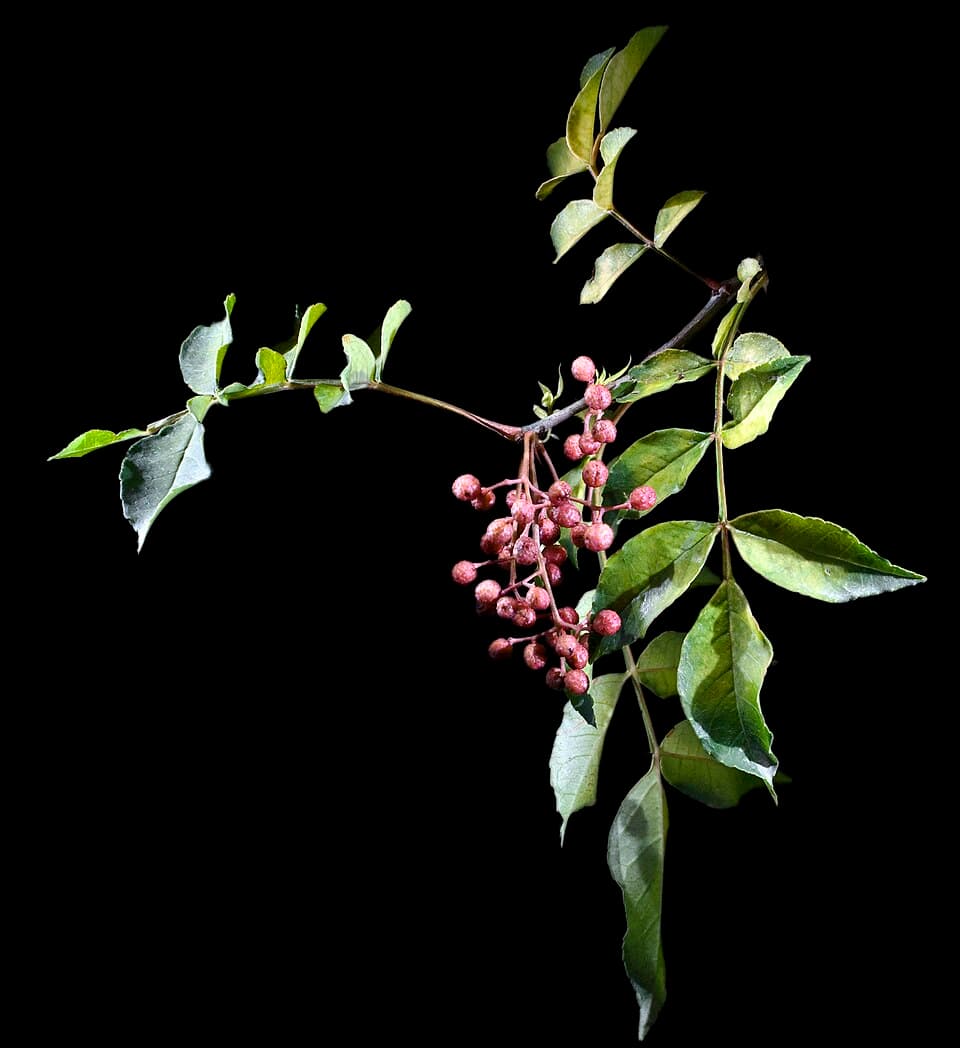
Tổng Quan
- Danh pháp khoa học
- Zanthoxylum piperitum DC
- Họ thực vật
- Rutaceae
- Bộ phận dùng
- Dried pericarp / fruit (vỏ quả khô — còn gọi là "huá jiāo" 花椒)
- Phương pháp chiết xuất
- Steam distillation (chưng cất hơi nước) hoặc CO₂ supercritical extraction (cho CO₂ select)
- Màu sắc
- Pale yellow to greenish-yellow, mobile liquid
- Phân loại nốt hương
- Nốt Top/Middle
- Hương thơm
- Top-Middle note; warm, spicy, citrusy, woody, slightly numbing (tê lưỡi — đặc trưng sanshool)
- Chemotype / Cultivar
- Significant compositional variation by plant part and season — Fruit/pericarp oil: β-phellandrene dominant; Leaf oil: citronellal dominant; Winter harvest yields higher sesquiterpenes
Các quốc gia sản xuất chính
China (Sichuan, Shaanxi, Gansu)Japan (Sanshō variety)KoreaNepal
Tình trạng tại Việt Nam
Xem chi tiết
Phân loại nốt
Top-Middle
Cường độ
7/5
Độ bền trên da
2–4 giờ
Họ hương
Spicy
Hương đầu (Opening)(0–15 phút)
Tingling spicy, characteristic numbing, warm woody spice, wild, olfactory awakening
Hương giữa (Heart)(15–60 phút)
Cay nồng râm ran, tê the đặc trưng, ấm áp gỗ gia vị, hoang dã, đánh thức khứu giác
Hương nền (Drydown)(1–4 giờ)
2–4 giờ
Cường độ hương
7/5
Da khô
3/5
Warming có lợi cho tuần hoàn; cần carrier nourishing; không dùng >1%
Da dầu/mụn
3/5
Antibacterial có lợi; tránh vượt 1%; patch test trước
Da lão hóa
3/5
Stimulating circulation — tích cực; nhưng da lão hóa nhạy cảm hơn; max 1%
Da thường
4/5
Phù hợp tốt trong massage và warming serum ≤1–2%
Da nhạy cảm
2/5
Cẩn thận — monoterpene + spicy nature; patch test bắt buộc; max 0.5%
Da hỗn hợp
4/5
Phù hợp tốt ở 0.5–1%; tốt cho vùng chữ T
Nhập khẩuTier 3 Emerging
Tên gọi tại Việt Nam
Tinh dầu tiêu Tứ Xuyên — hoa tiêu; còn gọi: sẻn, xuyên tiêu, hạt tiêu Nhật
Pha Chế & Hòa Hợp
Antimicrobial — broad spectrum
Limonene and linalool constituents disrupt microbial cell membranes; class-level evidence from Rutaceae family EOs with comparable monoterpene profiles.
Ref: class-extrapolation from black pepper (Opdyke 1978, p.651-652) and Rutaceae family peers; Tisserand & Young 2014, Ch.13 p.755
Carminative / digestive tonic
Monoterpene-rich aromatic composition stimulates digestive secretions and reduces intestinal spasm; consistent with traditional Kampo and TCM applications of Z. piperitum.
Ref: Tisserand & Young 2014, Ch.13 p.755; traditional use (TCM/Kampo — widely accepted)
Circulatory stimulant (topical)
Warming monoterpene hydrocarbons including limonene promote superficial vasodilation when applied topically in diluted form.
Ref: class-extrapolation from black pepper EO (Opdyke 1978, p.651-652); Tisserand & Young 2014, Ch.13 p.755
Anti-inflammatory (topical)
Limonene is documented to modulate NF-κB-mediated pro-inflammatory cytokine pathways; class-level inference from monoterpene literature.
Ref: class-extrapolation from limonene-dominant Rutaceae EOs; Tisserand & Young 2014, Ch.13 p.755
Analgesic (mild, counter-irritant)
Monoterpene-mediated counter-irritant effect via TRPV1 pathway modulation possible at topical dilution; note sanshool-based numbing is non-volatile and absent from steam-distilled EO.
Ref: class-extrapolation from black pepper EO (Opdyke 1978); Tisserand & Young 2014, Ch.13 p.755
Antifungal (mild)
Limonene and geranyl acetate class constituents show antifungal activity in Rutaceae-family studies; evidence is preclinical and class-level only.
Ref: class-extrapolation from Rutaceae family EOs; Tisserand & Young 2014, Ch.13 p.755
Botany Journals 2021 botanyjournals
MIC vs E. coli & S. aureus = 10⁻³ µl/ml; sulfoximine detected — potential anticancer marker
In vitroCIR Safety 2023 cir-safety
HRIPT 110 người: 2% Zanthoxylum piperitum CO₂ extract = non-sensitizer; safe in cosmetics at current use levels
Human HRIPTScienceDirect sciencedirect
Review: sanshool activates TRPV1/TRPA1 → unique numbing-tingling mechanism; antinociceptive
ReviewTâm trạng: Stimulating, Uplifting
vitalityalertnessplayfulnessclarityjoycuriosity
Chakra
Solar Plexus (Manipura)
Ngũ hành
Fire
| Phương pháp | Liều lượng | Ghi chú |
|---|---|---|
| Diffusion (khuếch tán) | 2–4 drops / 100ml nước | 30–45 phút; phòng ăn/phòng làm việc; phối với bergamot hoặc cedarwood |
| Topical massage | 1–3% dilution | Carrier gợi ý: jojoba, sweet almond; warm-up cơ, joint pain relief |
| Bath (tắm) | 3–5 drops pha trong 1 tsp carrier | Pha với sweet almond trước; không nhỏ thẳng; stimulating bath |
| Inhalation (hít) | 1–2 drops trên khăn / inhaler stick | 3–5 phút; energy boost, tiêu hóa kém |
| Skincare (chăm sóc da) | 0.5–1% trong serum/dầu dưỡng | Không dùng vùng mắt; suitable cho oily, normal skin |
Dầu nền phù hợp
JojobaLiquid wax with indefinite shelf life mitigates limonene oxidation risk; neutral scent preserves the characteristic pepper aroma profile.
Sweet AlmondLightweight, mid-absorption carrier well-suited for massage; its mild emollient quality softens the warming sensation on skin.
Fractionated CoconutHighly stable, non-greasy base ideal for small dilutions; excellent skin penetration supports circulatory massage applications.
Kết hợp tốt với
SpicyCitrusWoodyResinousHerbaceous
Blend kinh điển
Black Pepper + Sichuan Pepper— spicy duet — chiều sâu và sự phức tạp trong masculine fragrance, curry-spice blends
Bergamot + Sichuan Pepper— citrus-spicy freshness; lý tưởng cho top note cologne unisex
Cedarwood + Sichuan Pepper— woody-spice grounding; base structure cho perfume nam
Ginger + Sichuan Pepper— double warming spice; synergy cho muscle rub và digestive blends
[Primary safety] Tisserand & Young, Essential Oil Safety 2nd Ed. — Spice oils principles applied [CITATION-NEEDED exact page for Z. piperitum]
[CIR Safety Assessment] CIR — Safety Assessment of Zanthoxylum piperitum-Derived Ingredients 2023 — https://www.cir-safety.org/sites/default/files/report_ZanthoxylumPiperitum_092023.pdf cir-safety
[Chemistry — GC/MS] PMC 2016 — Antinociceptive Activity of Z. piperitum EO — https://pmc.ncbi.nlm.nih.gov/articles/PMC4983354/ pmc.ncbi.nlm.nih
[Chemistry — seasonal] J. Ecol. Field Biol. 2012 — Seasonal variations EO composition — https://www.doc-developpement-durable.org/file/Culture/Culture-epices/poivrier-du-Sichuan doc-developpement-durable
[Chemistry — volatile] Semanticscholar — Classification Japanese Pepper GC/MS — https://pdfs.semanticscholar.org/9a6a/ac982f0aebb691af9de996c4459b25b5268f.pdf pdfs.semanticscholar
[Antimicrobial] Botany Journals 2021 — GC-MS & antibacterial Sichuan Pepper — https://www.botanyjournals.com/assets/archives/2021/vol6issue5/6-5-197-361.pdf botanyjournals
[Physical data] NHR Organic Oils SDS — Zanthoxylum EO — https://www.nhrorganicoils.com/uploads/20221108155812e_Zanthoxylum_SDS.pdf nhrorganicoils
[INCI / CAS] INCI Decoder — CAS 97404-53-0 — https://incidecoder.com/ingredients/zanthoxylum-piperitum-oil incidecoder
[VN Context — Xuyên tiêu] Long Châu — Xuyên tiêu YHCT — https://nhathuoclongchau.com.vn/thanh-phan/xuyen-tieu nhathuoclongchau.com
[VN Context — oleoresin] Ingreda.vn — Chiết xuất tiêu Tứ Xuyên — https://ingreda.vn/chiet-xuat-tieu-tu-xuyen-szechuan-pepper-oleoresin/ ingreda
[IFRA] IFRA 51st Amendment — No specific standard for Z. piperitum fruit EO cir-safety
[Data reliability] MODERATE-HIGH — CAS/INCI xác nhận; GC/MS từ PMC thật; CIR safety assessment 2023 từ nguồn chính thức; physical data từ NHR SDS; VN context từ Long Châu và Ingreda; IFRA: không có tiêu chuẩn riêng nên ghi unrestricted
An Toàn
Giới hạn da tối đa
5%
Giới hạn IFRA
None documented for steam-distilled Zanthoxylum piperitum fruit oil
Thai kỳ & Cho con bú
Tam cá nguyệt 1AVOID
Tam cá nguyệt 21.0%
Tam cá nguyệt 31.0%
Giới hạn độ tuổi
AVOID
Bảo quản
_conditions: Cool, dark, airtight. Avoid heat and direct light; monoterpene-rich oils oxidize oxidation_risk: High ``` Lưu ý vận chuyển: Flash point ~55°C → IATA Dangerous Goods Class 3 (Flammable Liquid, PG III) — cần khai báo khi vận chuyển hàng không nhrorganicoils `oxidation_risk: High` — β-phel