- Cymbopogon flexuosus Nees ex Steud. Poaceae, leaves, steam distillation. Citral (geranial + neral) ~75–90% — highest citral-driver oil trong Phase 3 Batch 6–7 cluster (vs Lemon leaf ~50%). Non-phototoxic. West Indian sibling C. citratus DC shares safety block, chemistry differs (higher β-myrcene 5.6–19.2%).
- Hazards: Drug interaction + Teratogenicity + Skin sensitization. Cautions all routes: CYP2B6 (Appendix B). Cautions oral: diabetes meds, pregnancy. Cautions dermal: hypersensitive/damaged skin, children <2y.
- Chemistry East Indian (Lawrence 1989 p.111, 2002f p.58): geranial 45.1–54.5% + neral 30.1–36.1% + geranyl acetate 0.1–4.0% + geraniol 0.2–3.8% + (+)-limonene 0.1–3.8% + β-myrcene trace–low + caryophyllene oxide 0–1.6% + linalool 0.4–1.3%.
- Max dermal: 0.7% (citral cap); Max daily oral pregnancy: 46 mg. Based on 90% citral content với dermal/oral citral limits 0.6% / 0.6 mg/kg (Citral profile Ch.14).
- Teratogenicity mechanism: Citral dose-dependently inhibits retinoic acid synthesis → fetal development affected. CYP2B6 inhibition via citral + geraniol → theoretical drug interaction. Modak & Mukhopadhaya 2011: citral 10/15/20 mg/kg/28d dose-dependently lowered plasma insulin + increased glucose tolerance obese rats (antidiabetic cardiovascular effect).
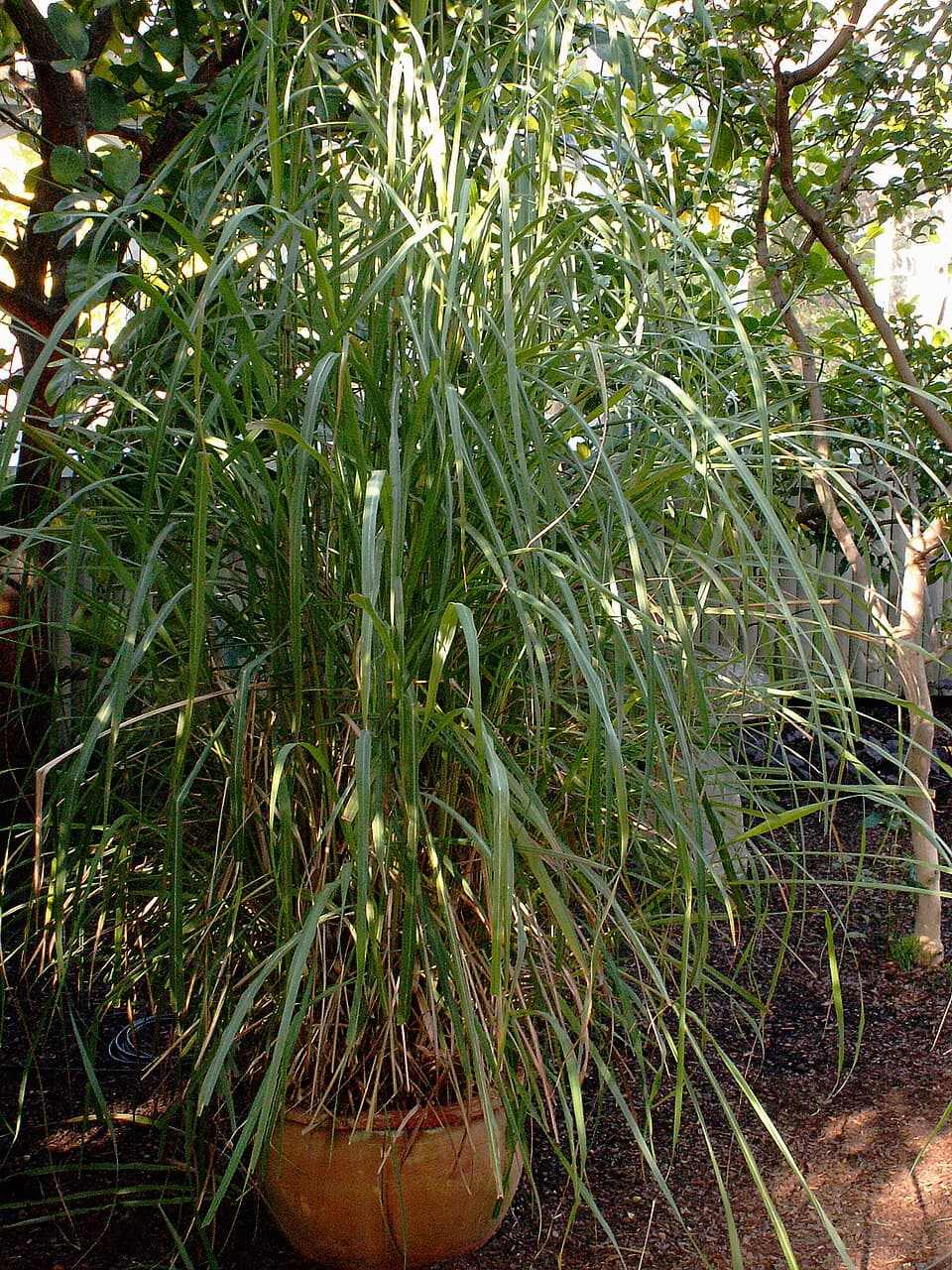
Tổng Quan
- Danh pháp khoa học
- Cymbopogon flexuosus Nees ex Steud.
- Họ thực vật
- Poaceae (Gramineae)
- Bộ phận dùng
- Aerial parts — leaves and stems (fresh or partially dried)
- Phương pháp chiết xuất
- Steam distillation
- Màu sắc
- Pale yellow to amber; darkens slightly with age
- Phân loại nốt hương
- Nốt Top/Middle
- Hương thơm
- Top–Middle note; intensely fresh, bright lemon-citrus, slightly herbaceous-grassy, with a light floral undertone from geraniol; cleaner and sharper than West Indian (*C. citratus*)
- Chemotype / Cultivar
- Citral chemotype (dominant); minor chemotypes with elevated myrcene or geraniol known; cultivar 'OD-19' and 'Krishna' are commercial Indian standards
Các quốc gia sản xuất chính
India (primary — KeralaTamil NaduKarnatakaUttar PradeshAssam)NepalSri LankaChina
Tình trạng tại Việt Nam
⭐⭐⭐ — Widely available as imported bulk oil; domestically produced C. flexuosus crops exist in limited scale; commonly mislabeled alongside C. citratus in Vietnamese market
Phân loại nốt
Top/Middle
Cường độ
8/5
Độ bền trên da
30 min – 2 hours (top-heavy volatile profile); fixation improved with benzyl benzoate or resinous bases
Họ hương
Citrus
Hương đầu (Opening)(0–15 phút)
Bright lemon, fresh, grassy, slightly floral, clean
Hương giữa (Heart)(15–60 phút)
Chanh tươi sáng, thanh mát, hơi cỏ cây, nhẹ hoa, sạch sẽ
Hương nền (Drydown)(1–4 giờ)
30 min – 2 hours (top-heavy volatile profile); fixation improved with benzyl benzoate or resinous bases
Cường độ hương
8/5
Da khô
2/5
NOT recommended as primary oil — citral can exacerbate dryness and irritation; use only at very low % with rich carrier
Da dầu/mụn
4/5
Excellent antibacterial + astringent action on excess sebum; use ≤0.7% leave-on; combine with tea tree
Da lão hóa
3/5
Antioxidant properties beneficial but irritation risk on thinning skin; use low % with nourishing carriers; combine with rosehip
Da nhạy cảm
1/5
HIGH CAUTION — citral is a known contact allergen; mandatory patch test; limit ≤0.5%; may trigger reactions in MCHI-positive individuals
Da hỗn hợp
3/5
Suitable for T-zone application only; keep away from dry zones; dilute well
Sản xuất tại VN** **Tier 2 Premium**
Vùng trồng / sản xuất tại VN
Lâm Đồng (Đà Lạt highlands — favorable climate for aromatic crops); Phú Yên; Đắk Lắk; limited cultivation in Hà Tĩnh and Nghệ An; most commercial East Indian lemongrass EO in VN market is imported from India
Tên gọi tại Việt Nam
Sả Đông ẤnSả dịuSả Ấn Độgeneral term Sả (covers multiple Cymbopogon spp.)traditional folk name cỏ sả
Trong Y học cổ truyền VN
Xông hơi (steam inhalation): Lá sả boiled in water, steam inhaled to treat cảm cúm, nghẹt mũi (nasal congestion), đau đầu — universal traditional practice across North and South Vietnam - Thuốc xoa bóp: Tinh dầu sả pha loãng dùng xoa bóp giảm đau cơ, đau khớp, côn trùng cắn - Ẩm thực dược liệu: Sả dùng trong nấu ăn (phở, lẩu, thịt nướng) với tác dụng kích thích tiêu hóa, kháng khuẩn thực phẩm - Đuổi muỗi/côn trùng: Truyền thống dùng cây sả trồng quanh nhà hoặc đốt để đuổi muỗi — đặc biệt phổ biế
Mua hàng tại VN
Imported Indian C. flexuosus EO available through aromatherapy distributors (Hà Nội, TP.HCM) at ~150,000–350,000 VND/10ml depending on origin and GC/MS certification; domestic production limited but growing; quality varies significantly — GC/MS verified product recommended; easily confused with C. citratus oil in local market
Pha Chế & Hòa Hợp
Antimicrobial
Citral (geranial + neral) disrupts microbial cell membranes and inhibits biofilm formation; demonstrated efficacy against S. aureus, MRSA, E. coli, Candida albicans, C. tropicalis; MIC of lemongrass EO against planktonic C. albicans = 0.0781% v/v;
Ref: PMC7783362 (Frontiers Cell. Infect. Microbiol. 2020)
Anti-inflammatory
Citral reduces proinflammatory cytokine release (IL-1β, TNF-α, IL-6); β-caryophyllene acts as selective CB2 cannabinoid receptor agonist;
Ref: PMC8773226 (Foods 2022); DOI:10.3389/fcimb.2020.603858
Antioxidant
High DPPH radical scavenging capacity; IC₅₀ = 43.67 μg/mL in Uttarakhand GC/MS study; polyphenolic content synergizes with citral;
Ref: JANS 2020 (Chowdhury et al.)
Insect repellent
Citral + citronellal + geraniol combination; effective topical repellent against Aedes aegypti and houseflies;
Ref: PMC8773226
Analgesic / antinociceptive
Myrcene component reduces pain perception via opioid pathway modulation; topical application reported to reduce RA pain scores;
Ref: PMC10892616 (scoping review 2024)
Antifungal
Disrupts ergosterol synthesis in fungal cell membranes; effective against dermatophytes and Candida spp.;
Ref: PMC7783362
PMC7783362 (2020)
LGEO + citral inhibit dual-species S. aureus / Candida biofilms; MIC 0.039–0.0781%
Moderate — in vitroPMC10892616 (2024)
Scoping review: analgesic, antifungal, anti-inflammatory applications supported across multiple clinical and preclinical studies
Moderate — Scoping ReviewPMC8773226 (2022)
Comprehensive review confirms antimicrobial, antioxidant, anti-inflammatory; highlights citral as primary bioactive
Moderate — Systematic ReviewPMID:19423120 (Ohno et al. 2009)
Lemongrass EO aromatherapy reduced anxiety and cortisol in pilot RCT
Low — pilot RCTTâm trạng: ** Uplifting + Clarifying + mildly Energizing; reduces mental fatigue and nervous tension
Mental clarityemotional cleansingself-confidencealertnessstress release
Chakra
** Solar Plexus (Manipura) ☀️
Ngũ hành
Wood
| Phương pháp | Liều lượng | Ghi chú |
|---|---|---|
| Diffusion (khuếch tán) | 3–5 drops per 100ml water | Max 30–60 min sessions; blends well with lavender or eucalyptus; strong — use less in small rooms |
| Topical massage (massage) | 0.5–1% dilution | Must dilute — neat application causes sensitization; use in jojoba or sweet almond; max 1% per IFRA/Tisserand citral limit |
| Bath (tắm) | 3–5 drops dispersed in 1 tsp liquid castile soap or milk first | NEVER add undiluted — citral irritates mucous membranes; short soak 10–15 min |
| Inhalation (hít) | 1–2 drops on tissue / personal inhaler | 5–10 min intervals; helpful for mental clarity and respiratory congestion |
| Skincare (chăm sóc da) | ≤0.7% in leave-on / ≤5% in rinse-off | Due to citral sensitization risk; patch test mandatory; non-comedogenic; excellent for oily/acne skin at safe dilutions |
| Insect repellent spray | 1–2% in isopropyl alcohol + distilled water | Effective but reapply every 1–2 hours; add cedarwood or citronella for duration |
Dầu nền phù hợp
Jojoba (Simmondsia chinensis)Non-greasy, stable, non-comedogenic; ideal for oily/acne skin formulations; excellent skin penetration enhancer for citral
Sweet Almond (Prunus amygdalus dulcis)Light texture, skin-softening; good dilution medium for massage; widely available in Vietnam
Hemp Seed (Cannabis sativa)High linoleic acid; ideal for anti-inflammatory skin blends; enhances beta-caryophyllene's anti-inflammatory synergy
Fractionated CoconutOdorless, very stable, widely available (VN: dầu dừa phân đoạn); good general-purpose carrier
Kết hợp tốt với
CitrusHerbFloralWood (light)Spice (light)
Blend kinh điển
Lavender + Lemongrass— Calming + cleansing; widely used diffuser blend for stress relief
Eucalyptus Globulus + Lemongrass— Powerful antibacterial room spray; respiratory clarity
Cedarwood Atlas + Lemongrass— Grounds the top note; excellent insect-repellent blend
Geranium Bourbon + Lemongrass— Floral-citrus skin toner; sebum-balancing for oily skin
Frankincense + Lemongrass— Meditative; bridges resinous base with bright citrus top
[Primary safety — dermal limit] Tisserand R & Young R. Essential Oil Safety, 2nd ed. Churchill Livingstone, 2014. Citral dermal max 0.6–0.7% (pp. 194, 282)
[GC/MS Chemistry #1] Chowdhury JA et al. "Chemical composition and antioxidant activity of EO of C. flexuosus." J. Appl. Nat. Sci. 12(1), 2020. DOI:10.31018/jans.v12i1.2207
[GC/MS Chemistry #2] Wild population Bangalore: Botanyjournals.com 2021, Vol.6(2):5-5-125-890 — 40+ compounds identified
[GC/MS Chemistry #3] Karnataka study: citral 64.98%, rjpn.org/ijcspub/papers/IJCSP10A1499.pdf
[Antimicrobial — Biofilm] Koo S et al. "Antimicrobial Activity of Lemongrass EO (C. flexuosus) and Citral Against Dual-Species Biofilms." Front. Cell. Infect. Microbiol. 2020. DOI:10.3389/fcimb.2020.603858 — PMC7783362
[Comprehensive review] Sharma PR et al. "Lemongrass EO Components with Antimicrobial and Antifungal Properties." Foods 2022. PMC8773226
[Clinical scoping review] Varghese SM et al. "Exploring Clinical Applications of LGEO: A Scoping Review." PMC10892616, 2024
[Food safety / animal safety] EFSA FEEDAP Panel on C. flexuosus EO safety. EFSA Journal 2023. PMC10369294
[VN traditional use] oking.vn — Cymbopogon taxonomy and VN names; charmevietnam.com — C. flexuosus VN cultivation notes
[VN agricultural study] Tạp chí Nông nghiệp VNUA: Đánh giá sinh trưởng Cymbopogon spp. tại Việt Nam. tapchi.vnua.edu.vn 2023
[IFRA citral restriction] IFRA Standards 49th Amendment — Citral restricted in leave-on cosmetics Category 4: 0.71%
[Data reliability] HIGH — Multiple peer-reviewed GC/MS studies; Tisserand & Young primary safety source; EFSA regulatory review; consistent chemistry across geographic origins
An Toàn
Giới hạn da tối đa
Xem chi tiết
Giới hạn IFRA
** Listed under IFRA Standards — citral restricted; always check batch certificate and calculate based on actual GC/MS citral content
Thai kỳ & Cho con bú
Tam cá nguyệt 1Unknown
Tam cá nguyệt 2Unknown
Tam cá nguyệt 3Unknown
Giới hạn độ tuổi
Xem chi tiết
Genuine: GC/MS shows total citral (geranial + neral) ≥ 65%; geranial peak larger than neral peak; β-myrcene 5–10%; trace geranyl acetate present; optical rotation (−3° to −1°); refractive index 1.483–1.489 Adulteration risks: Synthetic citral addition (cheapest adulterant — flattens GC profile); blending with C. citratus oil (lower citral, different myrcene ratio); addition of isolated limonene or terpene fractions to increase volume Storage: Dark glass bottle; cool (8–15°C); away from light and
Bảo quản
Dark glass bottle; cool (8–15°C); away from light and heat; shelf life 1–2 years (citral oxidizes to degradation products that increase sensitization risk); refrigeration recommended in VN tropical climate; discard if color darkens significantly to brown or develops rancid/metallic off-note