- Ocimum tenuiflorum L. (syn. O. sanctum L.; Lamiaceae), leaves, steam distillation. Sacred / holy basil / Tulsi — Indian Ayurvedic hallmark herb; DIFFERENT SPECIES from sweet basil (O. basilicum — see [[basil-linalool-ct]]). Eugenol chemotype (only commercially available as of 2014) = eugenol 31.9–50.4% + 1,8-cineole 12.6–16.5% + estragole 9.7–12.9% + methyleugenol 0.2–0.3% + β-bisabolene 9.7–10.5%. Kothari 2005a notes a >70% methyleugenol CT "released for commercial cultivation" — CT misidentification risk rising.
- Hazards: May contain methyleugenol; drug interaction (MAO-A → pethidine/MAOI/SSRI — Tao 2005); may inhibit blood clotting (eugenol + estragole); skin sensitization (MODERATE); mucous membrane irritation (low). Cautions (oral): pethidine, MAOIs, SSRIs, anticoagulants, major surgery, peptic ulcer, hemophilia, bleeding disorders.
- Dermal cap split by driver: Carcinogen-driven (estragole 12.9% + methyleugenol 0.3%) = EU 0.07% / IFRA 0.05%. Eugenol-driven = T&Y 1.0% (50.4% × 0.5% cap). T&Y overrides carcinogen cap per matrix antimutagenic signal (Aruna & Sivaramakrishnan 1996 GST +78%; Manosroi 2005 chemopreventive KB + P388). "Purely on the basis of estragole + methyleugenol content our dermal maximum would be 0.7%" but T&Y adopts 1.0% eugenol-based because EO is anticancer in practice.
- Not pregnancy-contraindicated but framework-cautious due to eugenol-MAO-A interaction + estragole signal. Drug interaction rail = clinically significant — eugenol 50.4% × MAO-A inhibition (Tao 2005) places holy basil in the clinical-MAOI-risk bracket ALONGSIDE clove bud. Most assertive drug-interaction profile of any Lamiaceae besides clove.
- Potent anticancer + antioxidant: DPPH IC₅₀ 0.26 µL/mL (Salles Trevisan 2006); B[a]P-induced squamous cell stomach carcinoma inhibited + GST +78% (Aruna 1996); KB + P388 chemopreventive IC₅₀ 95/85 µg/mL more effective than 3/4 positive controls (Manosroi 2005). Ayurvedic rasāyana indication backed by in vitro data.
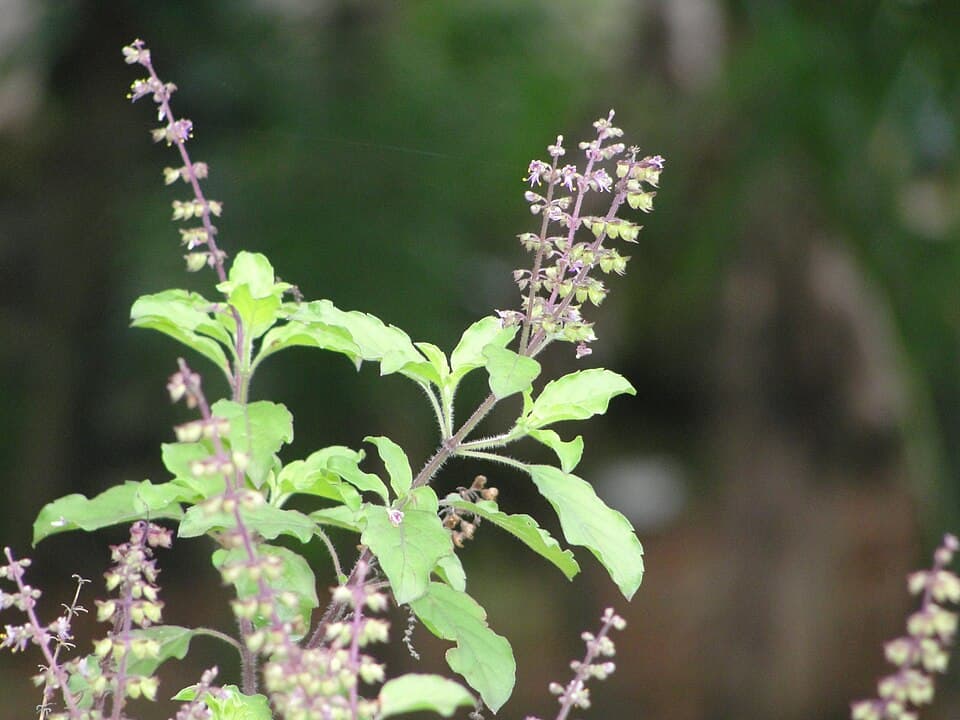
Tổng Quan
- Danh pháp khoa học
- Ocimum tenuiflorum L.
- Họ thực vật
- Lamiaceae (Labiatae)
- Bộ phận dùng
- Whole flowering plant / leaves and aerial parts
- Phương pháp chiết xuất
- Steam distillation / Hydrodistillation
- Màu sắc
- Pale yellow to yellow-orange liquid
- Phân loại nốt hương
- Nốt Middle
- Hương thơm
- Middle; Warm spicy-clove, herbal-camphoraceous, slightly sweet with earthy woody undertone
- Chemotype / Cultivar
- CT Eugenol (most common commercial) — "Krishna Tulsi" / "Vana Tulsi": Eugenol 40-80%, beta-Caryophyllene 10-22%. CRITICAL: CT Methyl Eugenol (70-83%) is RESTRICTED (IFRA/SCCS genotoxic); CT Methyl Chavicol is GENOTOXIC. This entry = CT Eugenol only.
Các quốc gia sản xuất chính
IndiaSri LankaNepalIndonesia
Tình trạng tại Việt Nam
⭐⭐ — Hiếm tại VN; chủ yếu import từ Ấn Độ qua các nhà phân phối tinh dầu đặc biệt
Phân loại nốt
Middle
Cường độ
8/5
Độ bền trên da
1 hour – 4 hours
Họ hương
Spicy
Hương đầu (Opening)(0–15 phút)
Clove-like, warm, herbal, camphoraceous, earthy-sacred
Hương giữa (Heart)(15–60 phút)
Cay ấm như đinh hương, thảo mộc linh thiêng, đất trầm, nồng dịu
Hương nền (Drydown)(1–4 giờ)
1 hour – 4 hours
Cường độ hương
8/5
Da khô
2/5
Eugenol dễ gây khô và kích ứng da khô
Da dầu/mụn
3/5
Kháng khuẩn mạnh nhưng eugenol cao dễ kích ứng; pha ≤0.1%
Da lão hóa
2/5
Da lão hóa nhạy cảm hơn với eugenol
Da thường
3/5
Pha ≤0.5%; test patch bắt buộc 48h
Da nhạy cảm
1/5
KHÔNG DÙNG — eugenol là sensitizer mạnh
Da hỗn hợp
2/5
Cực kỳ thận trọng; chỉ nồng độ cực thấp ≤0.05%
Nhập khẩuImported Only
Vùng trồng / sản xuất tại VN
Cây O. tenuiflorum có thể trồng được ở VN khí hậu nhiệt đới nhưng không thương mại hóa tinh dầu`
Tên gọi tại Việt Nam
Tinh dầu Húng Quế Thánh (Tulsi)
Trong Y học cổ truyền VN
Không có ứng dụng YHCT Việt Nam cụ thể cho O. tenuiflorum; cây O. basilicum (húng quế thường) có ứng dụng YHCT VN ghi nhận bởi Trungtamthuoc web:95; Tulsi được biết đến tại VN chủ yếu qua cộng đồng yoga, Ayurveda và wellness` `- VN sourcing notes: Tinh dầu Holy Basil/Tulsi nhập khẩu từ Ấn Độ; ít phổ biến tại VN; giá tham khảo 250,000–500,000 VNĐ/10ml (organic Ấn Độ); tìm kiếm tại các nhà phân phối tinh dầu Ayurvedic hoặc yoga supply shops` `- VN Heritage category: Imported Only` `---` `
Mua hàng tại VN
Tinh dầu Holy Basil/Tulsi nhập khẩu từ Ấn Độ; ít phổ biến tại VN; giá tham khảo 250,000–500,000 VNĐ/10ml (organic Ấn Độ); tìm kiếm tại các nhà phân phối tinh dầu Ayurvedic hoặc yoga supply shops` `- VN Heritage category: Imported Only` `---` `
Pha Chế & Hòa Hợp
Adaptogenic / Stress & Immunity
Tulsi được nghiên cứu rộng rãi như adaptogen — giảm cortisol, hỗ trợ HPA axis; tinh dầu eugenol CT có tác dụng antimicrobial và anti-inflammatory bổ trợ
Anti-inflammatory
β-Caryophyllene là CB2 receptor agonist — tác dụng anti-inflammatory được chứng minh; eugenol ức chế COX-2 và NF-κB; synergy mạnh nhất trong tất cả Basil oils
Antimicrobial / Antifungal
Eugenol phá vỡ membrane vi khuẩn và nấm; O. tenuiflorum EO ức chế Aspergillus flavus và A. niger
Respiratory Support
Camphor và β-caryophyllene có tác dụng expectorant nhẹ và bronchodilatory; truyền thống Ayurveda dùng Tulsi cho hen suyễn, ho, viêm phế quản
Analgesic
Eugenol ức chế kênh natri — tác dụng local anaesthetic đã chứng minh trong nha khoa; anti-nociceptive trên mô hình in vivo
Hepatoprotective / Antidiabetic
Chiết xuất Tulsi bảo vệ gan chống độc tố; kiểm soát đường huyết lúc đói và lipid máu
PMC 2024, PMID: 39497854
Comprehensive review: anti-inflammatory, adaptogenic, antimicrobial, hepatoprotective
Systematic ReviewIJCMAS 2024
Antifungal và antiaflatoxigenic mạnh vs. Aspergillus spp.; potential green preservative
In vitroIomcworld 2020
GC-MS: Caryophyllene 22.265%, Eugenol 15.906%, Caryophyllene oxide 3.252%
Analytical GC-MSTâm trạng: Grounding, Balancing
Sacredcenteringpurifyingdevotionalprotective
Chakra
Heart Chakra (Anahata), Crown Chakra (Sahasrara)
Ngũ hành
Fire
| Phương pháp | Liều lượng | Ghi chú |
|---|---|---|
| Diffusion (khuếch tán) | 3–5 drops / 100ml nước | 20–30 phút; phòng thiền định; mùa cúm |
| Topical massage | 0.5–1% dilution | ⚠️ Pha loãng NGHIÊM NGẶT vì eugenol cao |
| Bath (tắm) | ⚠️ KHÔNG KHUYẾN DÙNG | Eugenol gây kích ứng niêm mạc trong bồn tắm |
| Inhalation (hít) | 1–2 drops trên khăn | 5–10 phút; không inhaler trực tiếp mũi |
| Skincare (chăm sóc da) | 0.05–0.1% | Giới hạn IFRA cực thấp cho leave-on |
Kết hợp tốt với
SpicyResinousWoodyEarthyFloral
Blend kinh điển
Sandalwood + Holy Basil Tulsi— sacred meditation blend; eugenol + santalols tạo accord ấm linh thiêng
Frankincense + Holy Basil Tulsi— immunity & meditative blend; β-caryophyllene synergy
Rose + Holy Basil Tulsi— complex floral-spicy-sacred; clove-rose accord cổ điển
Vetiver + Holy Basil Tulsi— grounding earthy blend; deep woody accord
[Primary safety] Tisserand & Young, Essential Oil Safety 2nd Ed. — Eugenol dermal limits, methyl eugenol genotoxicity; p. [DATA-NEEDED specific page]
[Chemistry / Primary] PMC 2024, PMID: 39497854 — Comprehensive Review of O. tenuiflorum Phytochemistry — [web:93] https://pmc.ncbi.nlm.nih.gov/articles/PMC11521583/
[Chemistry / Secondary] Flora Journal 2025 — GC-MS O. sanctum: eugenol dominant, chavicol 3.74%, methyl eugenol 2.73% — [web:107] https://www.florajournal.com/archives/2025/vol13issue2/PartA/12-6-27-333.pdf
[Chemistry / Methyl Eugenol CT] Horizone Publishing 2014 — Methyl eugenol 82.9% CT identification — [web:110] https://horizonepublishing.com/journals/index.php/PST/article/download/52/23/767
[Chemistry / Iomcworld] Iomcworld 2020 — Caryophyllene 22.265%, Eugenol 15.906% — [web:114] https://www.iomcworld.com/open-access/chemical-composition-of-ocimum-sanctum-essential-oil-by-gcms-analysis-60222.html
[Safety / Dermal] Essentria Aromatherapy School — Holy Basil dermal max, IFRA 0.05%, no bath use — [web:108] https://www.schoolofessentria.com/blog/holy-basil
[Safety / Methyl Eugenol] Naturkosmos SDS — Methyl eugenol ADI 150 μg/day, IFRA category limits — [web:111] https://naturkosmos.se/dokument/1120%20-%20Helig%20basilika%20Tulsi.pdf
[Safety / Antifungal] IJCMAS 2024 — Antifungal/antiaflatoxigenic O. tenuiflorum EO — [web:99] https://ijcmas.com/13-8-2024/Rajneesh%20Rao,%20et%20al.pdf
[INCI / CAS] SpecialChem CosIng + NHR Organic Oils Spec — OCIMUM TENUIFLORUM OIL, CAS 91845-35-1 — [web:102][web:103]
[Physical data] THREE Holistic Research Center — specific gravity, RI, extraction rate — [web:112] https://hrc.threecosmetics.com/en/essential-oil/detail/913/
[VN Context / YHCT] Trungtamthuoc.com — Húng quế YHCT VN — [web:95] https://trungtamthuoc.com/duoc-lieu/hung-que
[VN Context / Adaptogen] NaturMed Scientific VN — Tulsi benefits Vietnam — [web:91] https://naturmedscientific.com/vi/l%E1%BB%A3i-%C3%ADch-s%E1%BB%A9c-kh%E1%BB%8Fe-c%E1%BB%A7a-h%C3%BAng-qu%E1%BA%BF-th%C3%A1nh/
[Data reliability] MODERATE-HIGH — Chemistry data từ nhiều GC-MS sources; PMID thật từ PMC review 2024; Safety từ IFRA + Essentria Institute (chuyên nghiệp); IFRA limits cần verify với official IFRA Library cho batch-specific methyl eugenol; VN context có source thật dù limited
An Toàn
Giới hạn da tối đa
1%
Giới hạn IFRA
Yes — IFRA restricted strictly due to methyl eugenol content (genotoxic compound with ADI 150 ug/day)
Thai kỳ & Cho con bú
Tam cá nguyệt 1AVOID
Tam cá nguyệt 2AVOID
Tam cá nguyệt 3AVOID
Giới hạn độ tuổi
Children <2: AVOID; 2-6: AVOID; 6-12: 0.1% diffusion only
- ! Anticoagulants (eugenol inhibits platelet aggregation)
- ! MAO inhibitors (theoretical)
- ! Antiepileptics (camphor content)
- ! CYP1A2 medications (eugenol inhibits CYP1A2 in vitro)
- x All pregnancy stages
- x Children <6 years
- x Sensitive skin (eugenol allergen)
- x Bath use (eugenol irritates mucous membranes)
` `- Authentic CT Eugenol: Eugenol 40–80%, β-Caryophyllene 10–22%, Methyl eugenol <15% web:107web:114` `- Adulteration phổ biến: Pha synthetic eugenol; nhầm hoặc bán CT Methyl Eugenol như CT Eugenol; nhầm với Clove Bud EO (eugenol ~70–90%)` `- Authentication: GC/MS required — đặc biệt xác định methyl eugenol %; specific gravity >1.030 (cao hơn tất cả CT Linalool/CT Methyl Chavicol)` `- Phân biệt với Clove Bud: O. tenuiflorum có β-caryophyllene cao hơn, camphor, ocimene; Clove không c
Bảo quản
Cool, dark, airtight. Store below 25°C. Protect from heat — eugenol and methyl eugenol may oxidize. Oxidation Risk: Medium