- Mentha arvensis L. (Lamiaceae), leaves, steam distillation. "Cornmint / Japanese mint / Field mint / Bạc hà Á". Menthol-dominant sibling of [[peppermint]] — same Mentha genus, DIFFERENT species. Natural oil 70–90% menthol; commercial article is DEMENTHOLIZED (menthol-crystal separated, ~50% removed). Frequently used to ADULTERATE premium peppermint per Kubeczka 2002.
- Chemistry = menthol 28.8–34.7% (dementholized; natural 70–90%) + menthone 16.3–31.1% + isomenthone 6.8–12.1% + (+)-limonene 5.8–9.6% + menthofuran 0.4–0.6% + pulegone 0.4–1.3%. Kubeczka 2002 dementholized grade. Menthofuran LOW (0.4–0.6%) vs peppermint (tr–9.4% with ISO ceiling 8%) — this is the cornmint adulteration fingerprint: menthofuran-low signature unique to cornmint.
- Hazards: Choleretic + mucous membrane irritation (low). Contraindications (ALL routes) — triple-CI cluster inherited from peppermint: cardiac fibrillation, G6PD deficiency, "do not apply to or near the face of infants or children." Contraindications (oral): cholestasis. Cautions (oral): GERD.
- Numeric caps (T&Y dermal not explicitly numeric-capped): Dermal framework 3% adult / face 1% / T1 AVOID-framework. Oral maximum NOT explicitly specified in T&Y cornmint entry — framework-inherited from peppermint dual-driver logic adjusted for LOWER menthofuran/pulegone (≈ 1.2% pulegone + 0.6% menthofuran ceilings) → ≈ 200–250 mg/day adult equivalent. Oral LD50 rat 1.24 g/kg (Opdyke 1975 p.771–772) — higher toxicity than peppermint's 2.43–4.44 g/kg (Ch.14 menthol profile), flagging cornmint as the LOWER-LD50 sibling.
- Skin: Opdyke 1975 p.771–772 — 8% on 25 volunteers, neither irritating nor sensitizing; non-phototoxic. Commission E: 5–20% oil / 5–10% aqueous-alcoholic semisolid / 3–6 drops oral. NOT commercially adulterated except when used AS adulterant in peppermint (Singhal 1997). Dementholized cornmint is the DOMINANT commercial article — natural 70–90% menthol oil crystallizes on cooling and is rarely sold as-is.
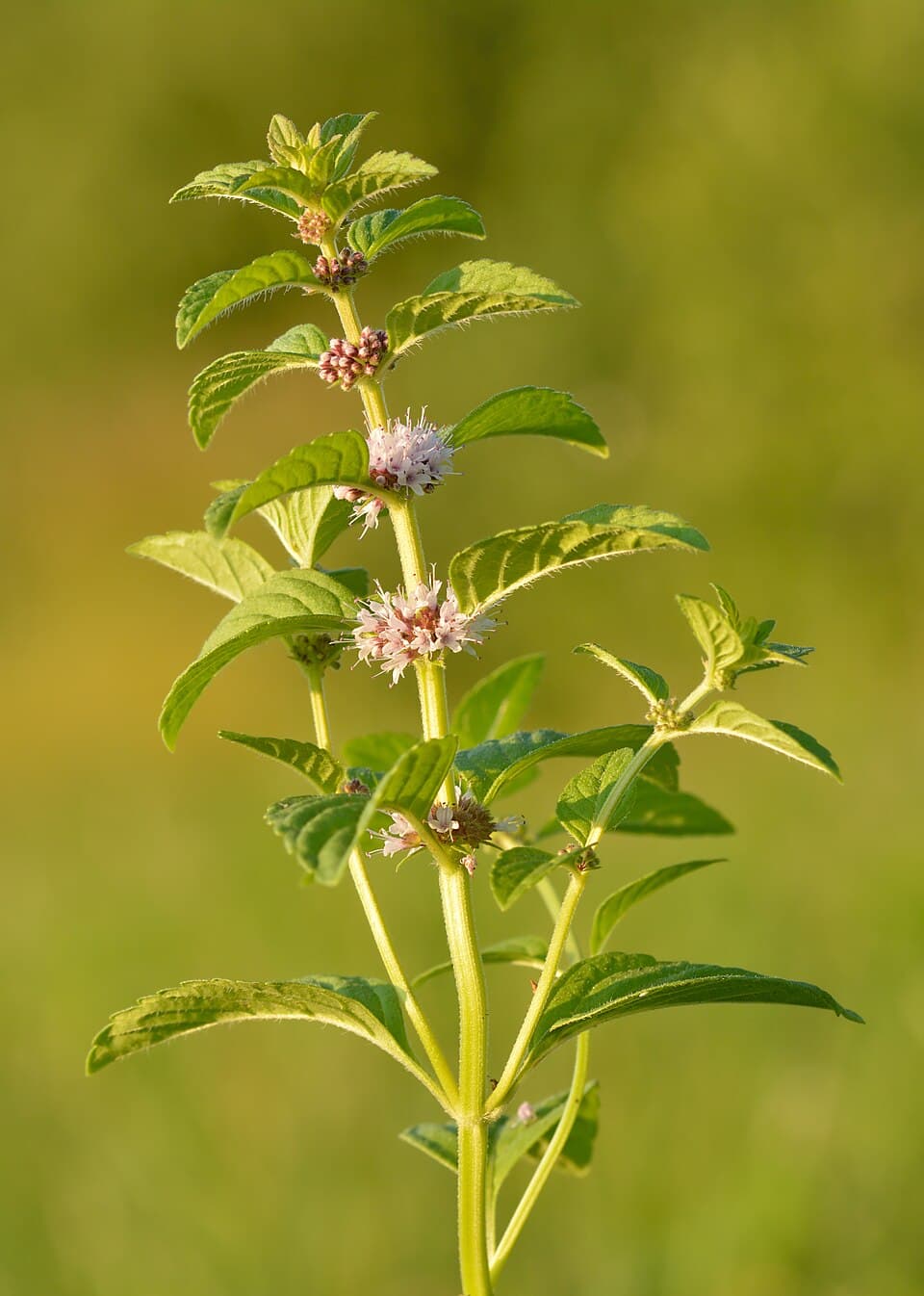
Tổng Quan
- Danh pháp khoa học
- Mentha arvensis L.
- Họ thực vật
- Lamiaceae
- Bộ phận dùng
- Toàn bộ aerial parts — lá, thân, hoa (thu hái tháng 5–6 tại VN)
- Phương pháp chiết xuất
- Steam distillation (chưng cất lôi cuốn hơi nước); tiếp theo là partial dementholization để sản xuất menthol crystals thương mại
- Màu sắc
- Colorless to pale yellow, mobile liquid (after dementholization có thể đục trắng khi lạnh do menthol crystals)
- Phân loại nốt hương
- Nốt Top/Middle
- Hương thơm
- Top-Middle note; intensely fresh, minty-cool, slightly medicinal, thô hơn M. piperita, ít phức tạp hơn nhưng mạnh hơn về menthol cold-blast
- Chemotype / Cultivar
- Menthol CT dominant (l-menthol 65–78%) — tiêu chuẩn thương mại; Dementholized grade (menthol crystals đã chiết xuất, để lại dementholized cornmint oil giàu menthone); Japan Mint (M. arvensis var. piperascens) cho menthol cao nhất đến 80%+
Các quốc gia sản xuất chính
India (Uttar Pradesh — Tarai region)ChinaVietnamBrazilNepal
Tình trạng tại Việt Nam
Xem chi tiết
Phân loại nốt
Top-Middle
Cường độ
9/5
Độ bền trên da
2–4 giờ
Họ hương
Camphoraceous
Hương đầu (Opening)(0–15 phút)
Intensely minty, sweet cooling, highly refreshing, cold herbal, awakening
Hương giữa (Heart)(15–60 phút)
The mát bùng nổ, the ngọt, sảng khoái cực độ, thảo mộc lạnh, đánh thức giác quan
Hương nền (Drydown)(1–4 giờ)
2–4 giờ
Cường độ hương
9/5
Da khô
2/5
Menthol cao drying effect rõ; tránh dùng trực tiếp; cần carrier nourishing đặc
Da dầu/mụn
4/5
Kháng khuẩn + astringent mạnh; ≤0.5% trong toner; menthol điều tiết bã nhờn
Da lão hóa
3/5
Vasodilatory có lợi nhưng menthol cao drying; dùng thấp ≤0.5%; cần carrier nourishing
Da thường
4/5
Tốt trong toner, serum cooling, scalp treatment ≤1–2%
Da nhạy cảm
2/5
Menthol >50% có thể gây kích ứng mạnh; patch test bắt buộc; max 0.25–0.5%
Da hỗn hợp
3/5
Phù hợp vùng T; tránh vùng má khô; ≤0.5%
Sản xuất tại VNTier 1 Champion
Tên gọi tại Việt Nam
Tinh dầu bạc hà đồng — bạc hà Á (còn gọi: bạc hà Việt Nam, húng cây, tinh dầu bạc hà)
Pha Chế & Hòa Hợp
Analgesic / counterirritant
Menthol (≥55%) is a potent TRPM8 cold-receptor agonist, producing cutaneous cooling and gating pain signal transmission via peripheral afferent fibres — yielding recognised counterirritant analgesia for muscular and joint pain.
Ref: Blumenthal et al. (1998) Commission E monograph [via B216]; Tisserand & Young 2014, Ch.13 p.549–550
Cooling / thermoreceptor stimulation
Menthol selectively activates the TRPM8 ion channel (threshold ~28 °C), generating an intense dose-dependent cooling sensation without actual tissue temperature change; useful for sport recovery, fever management, and headache relief.
Ref: Blumenthal et al. (1998) Commission E monograph [via B216]; Tisserand & Young 2014, Ch.13 p.549–550
Decongestant / nasal airway support
Menthol activates TRPM8 receptors in nasal mucosa, creating a perceived increase in airflow and reducing subjective nasal congestion sensation during inhalation.
Ref: Blumenthal et al. (1998) Commission E monograph [via B216]
Antispasmodic (smooth muscle)
Menthol inhibits calcium-channel–mediated smooth muscle contraction, relaxing gastrointestinal and bronchial musculature; inferred by class-extrapolation from the closely related peppermint species.
Ref: class-extrapolation from peppermint (Melis et al. 1989; Reynolds 1993 [via B216])
Antimicrobial (broad-spectrum)
Menthol disrupts microbial cell membrane integrity and inhibits membrane-bound enzymatic activity; broadly documented across menthol-dominant Mentha oils by structural analogy.
Ref: class-extrapolation from peppermint; Tisserand & Young 2014, Ch.13 p.549–550
Choleretic
Menthol-bearing Mentha extracts stimulate bile flow via hepatic secretory pathways; cornmint's high menthol content makes a class-level inference plausible, though not directly tested for Mentha arvensis EO.
Ref: class-extrapolation from peppermint (Reynolds 1993; Melis et al. 1989 [via B216])
Kim et al. 2016 (applied to cornmint menthol)
3% menthol-based oil promotes hair growth (equals minoxidil 3%) — cơ chế vasodilation scalp
Animal ControlledShegan.vn review shegan
Mentha arvensis extract điều tiết bã nhờn, chống viêm, kháng khuẩn trên da
ReviewVietPlantEx clinical claim vietplantex
Giảm đau cơ, hỗ trợ hô hấp, thanh lọc không khí — từ dữ liệu sử dụng thực tế VN
ObservationalTâm trạng: Stimulating, Uplifting
focusalertnessclarityinvigorationconcentrationwakefulness
Chakra
Throat (Vishuddha)
Ngũ hành
Metal
| Phương pháp | Liều lượng | Ghi chú |
|---|---|---|
| Diffusion (khuếch tán) | 3–5 drops / 100ml nước | 20–40 phút; phòng làm việc, phòng học; tránh khuếch tán lâu liên tục |
| Topical massage | 1–3% dilution | Jojoba hoặc sweet almond; muscle rub, headache roller; KHÔNG quá 3% trên mặt |
| Bath (tắm) | 3–5 drops pha trong 1 tsp carrier | ⚠️ Tránh nước nóng; pha với sweet almond; menthol mạnh + steam quá kích thích |
| Inhalation (hít) | 1–2 drops trên khăn / inhaler stick | 2–3 phút; respiratory + focus; xông mặt hiệu quả |
| Skincare (chăm sóc da) | 0.5% trong toner/serum | Non-comedogenic; không dùng vùng mắt; toner oily skin; scalp treatment 2–3% |
Dầu nền phù hợp
JojobaNon-comedogenic wax-ester; highly stable and ideal for oily/combination skin types that benefit most from cornmint's cooling and antimicrobial profile.
Sweet Almond OilLightweight oleic-acid carrier with excellent spreadability for massage blends targeting musculoskeletal pain; widely tolerated across skin types.
Fractionated Coconut OilOdourless and fast-absorbing; preserves the clean menthol topnote without competing base notes — preferred for sport-recovery and analgesic blends.
Arnica-infused Carrier OilSynergistic with cornmint's counterirritant action for muscular soreness; standard class-level pairing for topical pain blends.
Kết hợp tốt với
CamphoraceousHerbaceousCitrusResinousEucalyptus-family
Blend kinh điển
Eucalyptus Globulus + Cornmint— cặp đôi kháng khuẩn-hô hấp mạnh nhất; tiger balm, muscle rub, chest rub blends kinh điển
Lavender + Cornmint— minty-floral, làm dịu headache và căng cơ — headache roller blend phổ biến nhất VN
Rosemary + Cornmint— double stimulating; focus/study blend, scalp treatment kích thích mọc tóc
Tea Tree + Cornmint— anti-acne powerhouse; kháng khuẩn + cooling toner (≤0.5% mỗi loại)
[Primary safety] Tisserand & Young, Essential Oil Safety 2nd Ed. — Cornmint / Menthol sections [CITATION-NEEDED exact page]
[FEMA / FDA] FEMA 4219 — Cornmint Oil — https://www.femaflavor.org/flavor-library/cornmint-oil-mentha-arvensis-l femaflavor; FDA EAFUS — https://hfpappexternal.fda.gov/scripts/fdcc/index.cfm?set=FoodSubstances&id=CORNMINTOIL hfpappexternal.fda
[INCI / CAS] Exaflor TDS Mentha Arvensis Cornmint Oil — https://exaflor.co/images/HE_Anglais_-_Docs_r%C3%A9glementaires/Conv_essential_oils/CORNMINT_OIL_90063-97-1_TDS_V1.4.pdf exaflor
[Chemistry / SDS] NHR Organic Oils SDS — Organic Cornmint EO — https://www.nhrorganicoils.com/uploads/20180706142637e_Cornmint_SDS.pdf nhrorganicoils
[Chemistry / GC] The Good Scents Company — Cornmint 68917-18-0 — https://www.thegoodscentscompany.com/data/es1003041.html thegoodscentscompany
[IFRA Certificate] Essentials.com.pl IFRA 49th Amendment — Mentha Arvensis — https://essentials.com.pl/wp-content/uploads/2021/02/Certyfikat-IFRA-Olejek-naturalny-Wild-Mint-Mentha-Arvensis-EN.pdf essentials.com
[VN Production] VietPlantEx — Tinh dầu bạc hà Việt Nam — https://vietplantex.vn/tinh-dau-bac-ha-viet-nam/ vietplantex
[VN Context 2] Unilab Vietnam — Tinh Dầu Bạc Hà — https://unilabvietnam.com/san-pham/tinh-dau-bac-ha-unilab/ unilabvietnam
[VN YHCT] Shegan.vn — Mentha arvensis leaf extract — https://shegan.vn/blogs/minh-bach-nguyen-lieu/mentha-arvensis-leaf-extract shegan
[Data reliability] HIGH — CAS/INCI/FEMA từ nguồn FDA và FEMA chính thức; GC/MS từ NHR SDS thực; IFRA certificate từ nhà phân phối EU uy tín; VN data từ VietPlantEx (nhà sản xuất xuất khẩu thực); physical specs từ VietPlantEx và NHR khớp nhau
An Toàn
Giới hạn da tối đa
5.4%
Giới hạn IFRA
Yes — restricted via constituent profile (menthol, limonene, linalool) essentials.com
Thai kỳ & Cho con bú
Tam cá nguyệt 1AVOID
Tam cá nguyệt 21.0%
Tam cá nguyệt 31.0%
Giới hạn độ tuổi
AVOID
Bảo quản
_conditions: Cool, dark, airtight. Warm gently if crystals form (menthol crystallization normal). No refrigeration required. oxidation_risk: Medium ``` Lưu ý đặc biệt: Flash point 73°C → KHÔNG phải Dangerous Goods Class 3 — an toàn vận chuyển hàng không thông thường, không cần khai báo DG nhrorganic