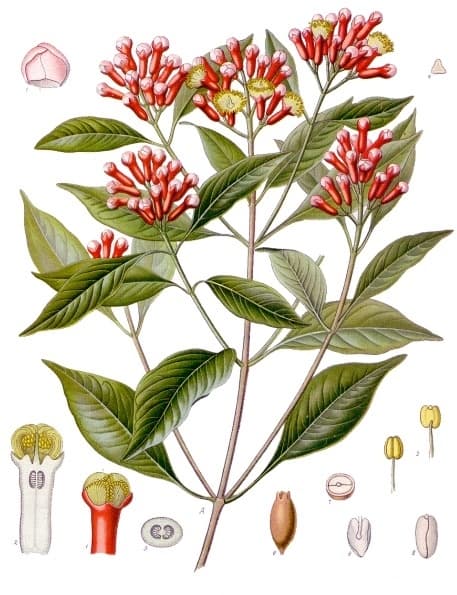
- Syzygium aromaticum (L.) Merrill et L.M. Perry. Myrtaceae, leaves (NOT bud, NOT stem), steam distillation. Eugenol 77.0–88.0% — same species as clove-bud + clove-stem, odor distinct per T&Y Comments. Non-phototoxic. Clove bud is most-used type; clove leaf = commonly adulterated INTO clove bud oil.
- Hazards: Drug interaction + Anticoagulant + Embryotoxicity + Skin sensitization (moderate) + Mucous membrane irritation (moderate). Note: no "may contain methyleugenol" caveat (leaf methyleugenol sub-detection in Lawrence 1995g). Cautions oral: pethidine, MAOIs, SSRIs; anticoagulant meds, major surgery, peptic ulcer, hemophilia. Cautions dermal: hypersensitive/damaged skin, children <2y AVOID.
- Chemistry (Lawrence 1995g p.178, p.198): eugenol 77.0–88.0% + β-caryophyllene 3.5–6.4% + α-caryophyllene 0.8–1.4% + eugenyl acetate trace–1.2% + isoeugenol trace.
- Max dermal: 0.6% (per T&Y based on 88% eugenol × 0.5% eugenol IFRA ≈ 0.57 ≈ 0.6%). Slightly looser than clove bud (0.5%) vì upper eugenol ceiling 88% vs 96.9%.
- Same pediatric oral hazard block as clove bud (T&Y Acute toxicity, human = "See clove bud"). Lalko & Api 2006 LLNA confirms weak sensitizer similar potency to pure eugenol. Not mutagenic. Anticarcinogenic via eugenol.
Tổng Quan
- Danh pháp khoa học
- Syzygium aromaticum (L.) Merrill et L.M. Perry
- Họ thực vật
- Myrtaceae
- Bộ phận dùng
- Leaves (Lá)
- Phương pháp chiết xuất
- Steam distillation
- Màu sắc
- Dark brown to yellowish-brown
- Phân loại nốt hương
- Nốt Middle
- Hương thơm
- Middle note; Harsh, woody, spicy, burnt-woody, lacking the sweet top notes of Clove Bud.
- Chemotype / Cultivar
- Eugenol CT
Các quốc gia sản xuất chính
IndonesiaMadagascar.
Tình trạng tại Việt Nam
★★★★☆ [Widely available, often sold generically as "Clove Oil"]
Phân loại nốt
Middle
Cường độ
8/5
Độ bền trên da
2 – 8 hours
Họ hương
Woody
Hương đầu (Opening)(0–15 phút)
Harsh, woody, spicy, slightly burnt, phenolic.
Hương giữa (Heart)(15–60 phút)
Mùi gỗ hắc, cay nồng, thô và kém ngọt hơn nụ đinh hương, có mùi khét nhẹ đặc trưng của phenol.
Hương nền (Drydown)(1–4 giờ)
2 – 8 hours
Cường độ hương
8/5
Da khô
1/5
Avoid.
Da dầu/mụn
1/5
Avoid on face; far too irritating.
Da lão hóa
1/5
Avoid.
Da nhạy cảm
1/5
strictly avoid.
Da hỗn hợp
1/5
Avoid.
Nhập khẩu** Imported
Vùng trồng / sản xuất tại VN
N/A (Mostly imported from Indonesia).
Tên gọi tại Việt Nam
Tinh dầu lá đinh hương (thường bị gọi chung là "tinh dầu đinh hương").
Trong Y học cổ truyền VN
Ít được phân biệt rõ ràng với nụ đinh hương trong tiêu dùng phổ thông. Thường được các xưởng chiết xuất nhập về khối lượng lớn để làm dung môi, nguyên liệu rẻ tiền sản xuất cao xoa bóp, xà phòng, hoặc chất sát khuẩn.
Mua hàng tại VN
Rất rẻ và dễ mua số lượng lớn (thường bán theo can/lít). Người mua thường bị nhầm lẫn và mua phải tinh dầu lá đinh hương khi thực chất họ muốn tìm tinh dầu nụ đinh hương (Bud) cho liệu pháp hương thơm.
Pha Chế & Hòa Hợp
Antimicrobial / Antiseptic
Extremely potent against bacteria and fungi due to eugenol;
Ref: PMID 38671935
Anti-inflammatory
High levels of both eugenol and β-caryophyllene make it a strong anti-inflammatory agent;
Ref: PMID 34770801
Analgesic
Pain-relieving properties, though less refined than the bud for direct topical or oral care applications.
PMID 38671935
Significant broad-spectrum antimicrobial activity against various pathogens.
In vitroPMID 34770801
Anti-inflammatory properties through modulation of signaling pathways.
In vitro / ReviewTâm trạng: ** Stimulating / Grounding
Fortifyingprotectiverobust.
Chakra
** Root (Muladhara)
Ngũ hành
Fire
| Phương pháp | Liều lượng | Ghi chú |
|---|---|---|
| Diffusion (khuếch tán) | 1 drop | Only in blends. Can highly irritate lungs and mucous membranes if diffused alone. |
| Topical massage (massage) | Max 0.5% | Heavily dilute for warming muscle rubs. Clove Bud is safer and preferred. |
| Bath (tắm) | NOT REC. | Do not use in baths. Risk of severe skin irritation. |
| Inhalation (hít) | NOT REC. | Too harsh for direct inhalation. |
| Skincare (chăm sóc da) | AVOID | Never use on the face. |
Dầu nền phù hợp
Jojoba waxExtremely stable, non-oxidising liquid wax — ideal for a highly potent low-dilution EO like clove leaf to minimise sensitisation cascade from a peroxidised carrier medium.
Sweet almond oilLightweight, oleic-acid-dominant emollient; spreads evenly at 0.5% dilution and does not compete with eugenol's warming analgesic effect in muscle-relief applications.
Fractionated coconut oilOdour-neutral, stable, medium-chain carrier with fast skin penetration; suited to antimicrobial blends where a clean scent profile and good shelf life are priorities.
Kết hợp tốt với
CitrusWoodSpice (Used very sparingly).
Blend kinh điển
—
—
—
—
[Primary safety] Essential Oil Safety (2nd Ed) - Tisserand & Young (p. 256 for Leaf profile typically matched by eugenol constraint)
[Clinical] PMID: 38671935, PMID: 34770801
[Chemistry] GC/MS profiles via CIRAD & typical sourcing analysis for Syzygium aromaticum leaves
[VN Heritage] Khảo sát thực tế thị trường nhập khẩu hương liệu VN
An Toàn
Giới hạn da tối đa
Xem chi tiết
Giới hạn IFRA
** Restricted due to eugenol content.
Thai kỳ & Cho con bú
Tam cá nguyệt 1Unknown
Tam cá nguyệt 2Unknown
Tam cá nguyệt 3Unknown
Giới hạn độ tuổi
Xem chi tiết
Genuine: Should have a dark color and harsh, woody-spicy scent. Adulteration risks: Clove leaf is usually the adulterant used to cut the more expensive Clove Bud oil. Storage: Dark, airtight container.
Bảo quản
Dark, airtight container.