- Syzygium aromaticum (L.) Merrill et L.M. Perry. Myrtaceae, dried flower buds, steam distillation. Eugenol 73.5–96.9% — highest eugenol driver trong cluster Clove × 3 + Cinnamon Leaf. Non-phototoxic. Same botanical species nhưng odor khác rõ rệt giữa bud / leaf / stem (T&Y Comments p.541).
- Hazards: Drug interaction + Methyleugenol + Anticoagulant + Embryotoxicity + Skin sensitization (moderate) + Mucous membrane irritation (moderate). Cautions oral: pethidine, MAOIs, SSRIs; anticoagulant meds, major surgery, peptic ulcer, hemophilia. Cautions dermal: hypersensitive/damaged skin, children <2y AVOID.
- Chemistry (Kubeczka 2002, Lawrence 1981 p.33–34, 1993 p.36): eugenol 73.5–96.9% + β-caryophyllene 0.6–12.4% + eugenyl acetate 0.5–10.7% + α-caryophyllene 0.4–1.4% + isoeugenol 0.1–0.2% + methyleugenol 0–0.2%.
- Max dermal: 0.5% (eugenol 0.5% IFRA cap, Tisserand & Young 0.5%). No oral cap specified in T&Y — multiple pediatric acute poisonings documented (Lane 1991 + Hartnoll 1993 + Janes 2005 = fulminant hepatic failure 10 mL).
- Methyleugenol (0–0.2%) is NOT dose-limiting — eugenol cap (0.5% oil) more restrictive than methyleugenol cap (10% oil at 0.2% methyleugenol × 0.0004% leave-on IFRA). Embryotoxicity signal (Domaracky 2007 mice 0.25%=375 mg/kg) is rationalized down by Amini 2003 pure eugenol 100 mg/kg no effect → no absolute pregnancy contraindication per T&Y.
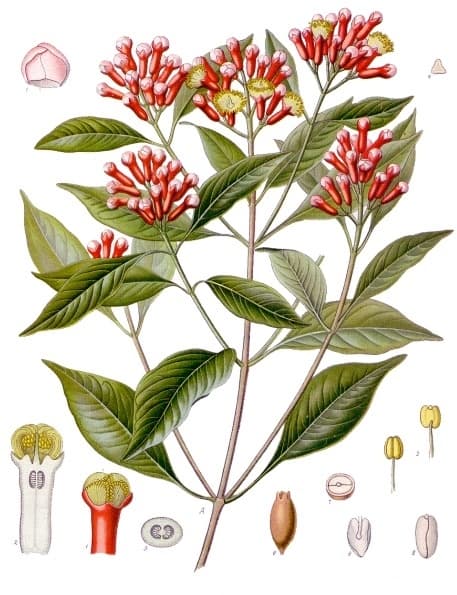
Tổng Quan
- Danh pháp khoa học
- Syzygium aromaticum (L.) Merrill et L.M. Perry
- Họ thực vật
- Myrtaceae
- Bộ phận dùng
- Buds (Nụ hoa khô)
- Phương pháp chiết xuất
- Steam distillation
- Màu sắc
- Pale yellow to golden brown
- Phân loại nốt hương
- Nốt Middle/Base
- Hương thơm
- Middle to Base note; Spicy, warm, woody, sweet, slightly medicinal.
- Chemotype / Cultivar
- Eugenol CT
Các quốc gia sản xuất chính
IndonesiaMadagascarSri LankaIndia.
Tình trạng tại Việt Nam
★★★☆☆ [Imported mostly, but widely available in pharmacies and essential oil shops]
Phân loại nốt
Middle/Base
Cường độ
8/5
Độ bền trên da
2 – 12 hours
Họ hương
Spicy
Hương đầu (Opening)(0–15 phút)
Spicy, warm, penetrating, sweet, woody.
Hương giữa (Heart)(15–60 phút)
Ấm nồng, cay ngọt, đậm đà, hơi hắc mùi mộc, đặc trưng mùi phòng nha (nha khoa).
Hương nền (Drydown)(1–4 giờ)
2 – 12 hours
Cường độ hương
8/5
Da khô
1/5
Avoid, may cause further sensitization.
Da dầu/mụn
2/5
Antibacterial but too irritating for facial acne. Tea tree is preferred.
Da lão hóa
1/5
Not recommended for facial care.
Da nhạy cảm
1/5
strictly avoid on sensitive skin.
Da hỗn hợp
1/5
Avoid on face.
Nhập khẩu** Imported
Vùng trồng / sản xuất tại VN
N/A (Mostly imported from Indonesia, Madagascar).
Tên gọi tại Việt Nam
Đinh hươngTử đinh hương (lưu ý tránh nhầm với hoa Lilac).
Trong Y học cổ truyền VN
Sử dụng dạng nụ khô làm gia vị, ngâm rượu xoa bóp trị đau nhức xương khớp. - Sử dụng làm bài thuốc trị nhức răng (ngậm nụ khô hoặc nhét bông tẩm tinh dầu vào chỗ răng cấm sâu).
Mua hàng tại VN
Very easy to find as a spice or cheap imported essential oil. However, high-quality, unadulterated Clove Bud oil specifically extracted for aromatherapy is harder to find locally, as the market is flooded with industrial Clove Leaf oil labeled simply as "Clove Oil".
Pha Chế & Hòa Hợp
Analgesic (Dental)
Strong local anesthetic, specifically for toothache and oral pain;
Ref: PMID 31869191 / PMID 37504233
Antimicrobial / Antifungal
Broad-spectrum action against bacteria and fungi due to high phenol content.
Anti-inflammatory
Reduces inflammation and swelling, particularly in joint/muscle blends;
Ref: PMID 26333873
PMID 31869191
Eugenol gel (2%) was as effective as 10% benzocaine in reducing acute toothache intensity.
Moderate RCTPMID 37504233
Eugenol was more effective than articaine for pain reduction on day one after emergency coronal pulpotomy.
Human RCTPMID 26333873
Clove oil exhibited significant antinociceptive, anti-inflammatory, and antipyretic effects in animal models.
In vivo (Mice)Tâm trạng: ** Stimulating / Grounding / Warming
Courageboundariesmemory stimulationcomfort.
Chakra
** Root (Muladhara) / Solar Plexus (Manipura)
Ngũ hành
Fire
| Phương pháp | Liều lượng | Ghi chú |
|---|---|---|
| Diffusion (khuếch tán) | 1-2 drops | Blend with milder oils (like Sweet Orange). Can irritate mucous membranes if diffused alone or in high amounts. |
| Topical massage (massage) | Max 0.5% | Must heavily dilute. Ideal for warming muscle rubs or joint pain. |
| Bath (tắm) | NOT REC. | Do not use in baths due to high risk of mucous membrane and skin irritation. |
| Inhalation (hít) | 1 drop | Inhaler stick only, well-blended. |
| Skincare (chăm sóc da) | AVOID | Generally avoided in facial skincare due to irritation risk. |
Dầu nền phù hợp
JojobaLiquid wax with exceptional oxidative stability and no rancidity risk; mimics skin sebum and provides a controlled dilution medium that minimises eugenol's sensitizer potential.
Sweet almond oilGentle carrier with neutral scent and low comedogenicity; well-suited for diluting phenol-rich EOs at the strict 0.5% maximum without competing aroma interference.
Fractionated coconut oilOdourless, lightweight, and rapidly absorbed; ideal for precise small-batch 0.5% formulations; long shelf life eliminates compounding rancidity risk.
Kết hợp tốt với
CitrusFloralWoodSpice.
Blend kinh điển
—
—
—
—
[Primary safety] Essential Oil Safety (2nd Ed) - Tisserand & Young p. 254-255
[Clinical] PMID: 31869191, PMID: 37504233, PMID: 26333873
[Chemistry] GC/MS profiles via typical sourcing analysis (e.g., ISO 3142:1997 for Clove Bud)
[VN Heritage] Những cây thuốc và vị thuốc Việt Nam (GS. Đỗ Tất Lợi)
An Toàn
Giới hạn da tối đa
Xem chi tiết
Giới hạn IFRA
** Eugenol is restricted by IFRA standards depending on the product category.
Thai kỳ & Cho con bú
Tam cá nguyệt 1Unknown
Tam cá nguyệt 2Unknown
Tam cá nguyệt 3Unknown
Giới hạn độ tuổi
Xem chi tiết
Genuine: Should have a sweet-spicy note. Clove Bud is superior for aromatherapy compared to Clove Leaf or Stem (which are harsher and used mostly for industrial eugenol isolation). Adulteration risks: Frequently adulterated with cheaper clove leaf/stem oil or synthetic eugenol. Storage: Keep in dark, airtight bottles; prone to oxidation which increases sensitization risk.
Bảo quản
Keep in dark, airtight bottles; prone to oxidation which increases sensitization risk.