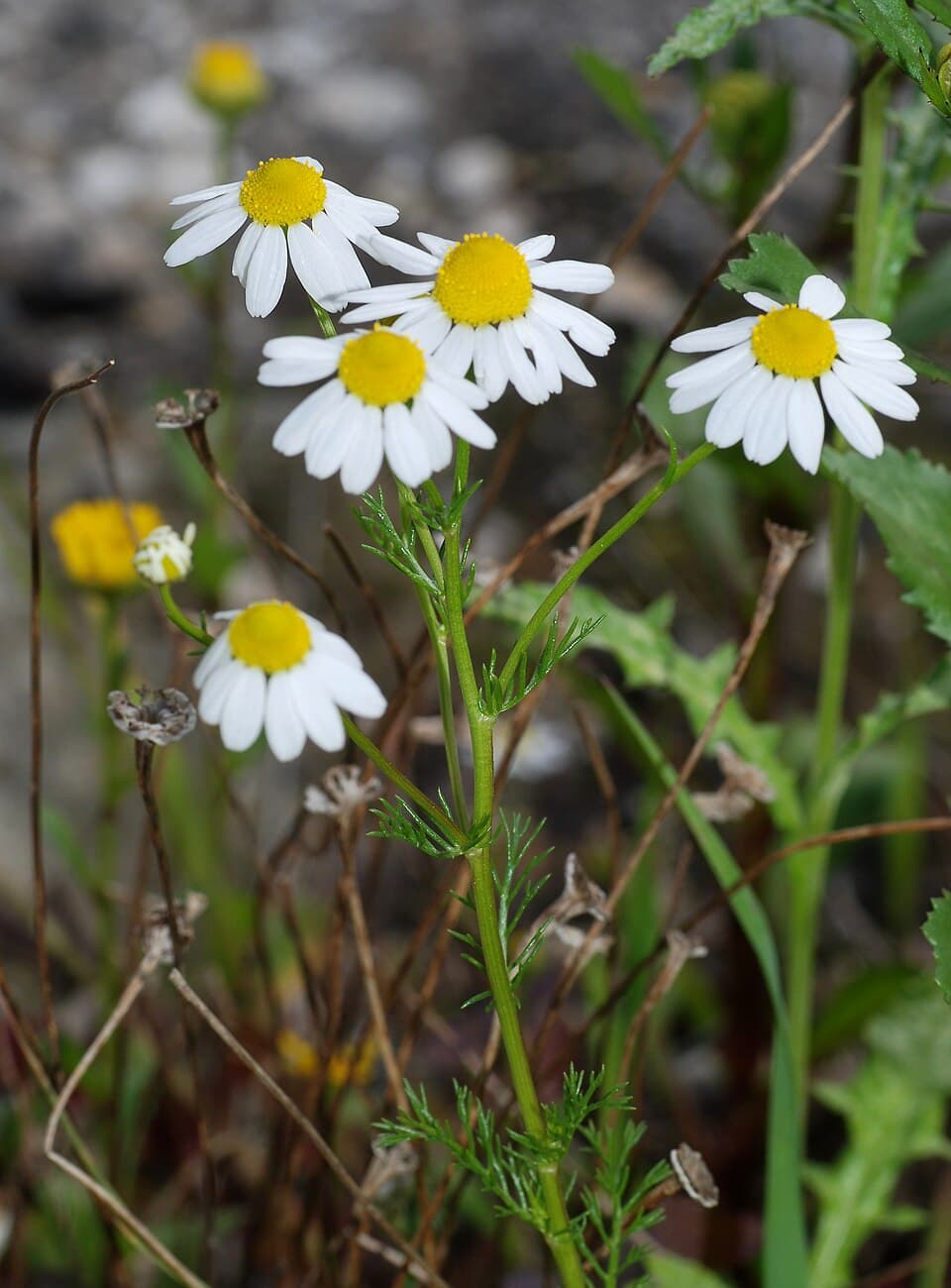
- Matricaria recutita L. — synonyms Chamomilla recutita (L.) Rauschert + Matricaria chamomilla L. (legacy). Asteraceae, aerial parts flowering plant, steam distilled. KHÔNG phải Chamomile Roman — different genus (Matricaria vs Chamaemelum) + completely different sesquiterpene/azulene chemistry class.
- Hazards: Drug interaction. Contraindications: None known. Cautions (all routes): drugs metabolized by CYP2D6. Cautions (oral only): drugs metabolized by CYP1A2/CYP2C9/CYP3A4 depending on chemotype.
- 6 defined chemotypes (unique among aromatherapy oils): α-bisabolol oxide A/(E)-β-farnesene Egyptian (Shaath 1993), α-bisabolol oxide A Egyptian/German/Dutch (Piccaglia 1993), α-bisabolol oxide A/B Brazilian (Matos 1993), farnesene/chamazulene Bulgarian (Tsutsulova 1984), α-bisabolol/(E)-β-farnesene Finnish (Hyvönen 1991), α-bisabolol oxide A/chamazulene German (Brunke 1992).
- Max dermal: No limit T&Y (SYMELab 5% platform cap); non-phototoxic (Opdyke 1974 p.851–852). GRAS status. Chamazulene signature gives deep-blue oil color (2.7–23.4% across CTs).
- Drug-interaction hazard = shared cluster mechanism via chamazulene + farnesene + α-bisabolol CYP2D6 inhibition (Table 4.11B). α-Bisabolol CTs additionally inhibit CYP1A2. Chemotypes high α-bisabolol preferred for therapy per T&Y Comments p.520.
Tổng Quan
- Danh pháp khoa học
- Matricaria recutita L.
- Họ thực vật
- Asteraceae (Compositae)
- Bộ phận dùng
- Flower heads (capitula) — dried, including aerial parts
- Phương pháp chiết xuất
- Steam distillation (standard); CO₂ supercritical extraction also used for higher chamazulene preserv
- Màu sắc
- Deep indigo to dark cobalt blue — characteristic color from chamazulene (formed during distillation from matricine precursor). Color fades to green/yellow-green upon oxidation or prolonged storage.
- Phân loại nốt hương
- Nốt Middle
- Hương thơm
- Middle note; sweet, herbaceous, warm, intensely floral-apple, slightly fruity-smoky, medicinal undertone. Distinctly different from Roman Chamomile — heavier, earthier, more medicinal.
- Chemotype / Cultivar
- Multiple chemotypes recognized: α-bisabolol CT (most common, Europe); bisabolol oxide A CT; en-yn-dicycloether CT; chamazulene-rich CT (high-grade therapeutic). Cultivar "Zloty Lan" (Poland) and "Manzana" (Germany) are well-known high-bisabolol strains.
Các quốc gia sản xuất chính
Egypt ★★★★★ (largest producer)Germany ★★★★Hungary ★★★★Poland ★★★★Slovakia ★★★Argentina ★★★Iran ★★★
Tình trạng tại Việt Nam
⭐⭐★★★ | Imported only; available from specialty aromatherapy suppliers in Hanoi/HCMC (e.g., Aroma Life VN, Tinh dầu nhập khẩu); price range 300,000–800,000 VNĐ/5ml depending on grade and origin; often adulterated with Roman chamomile or diluted in carrier oil — source verification critical.
Phân loại nốt
Middle note (occasionally brid
Cường độ
Đang cập nhật
Độ bền trên da
3–6 hours (middle note, moderate-good fixative quality)
Họ hương
[Primary: Herbal-Floral] [Secondary: Green / Earthy]
Hương đầu (Opening)(0–15 phút)
Apple-sweet, herbal, warm, straw-like, medicinal-smoky, slightly waxy
Hương giữa (Heart)(15–60 phút)
Ngọt táo – thảo mộc ấm – đất ẩm – y dược nhẹ – hoa khô
Hương nền (Drydown)(1–4 giờ)
3–6 hours (middle note, moderate-good fixative quality)
Da khô
5/5
Excellent; bisabolol enhances barrier function and moisture retention; combine with borage or rosehip
Da dầu/mụn
4/5
Antibacterial + anti-inflammatory reduces cystic acne inflammation; use at ≤1% to avoid pore congestion; jojoba carrier
Viêm da cơ địa
5/5
Top-tier evidence: reduces IgE, histamine, scratching; inhibits Th2/Th17 axis; use at 1% in borage/EPO carrier; Ref PMC2833428
Da lão hóa
5/5
Reduces chronic micro-inflammation ("inflammaging"); bisabolol stimulates collagen synthesis; chamazulene = antioxidant
Da nhạy cảm
5/5
One of aromatherapy's top choices for reactive skin; reduces redness, TEWL, and reactivity; patch test first for Asteraceae allergy
Da hỗn hợp
4/5
Balance sebum + soothe dry patches; use zone-specifically at 1–1.5%
Nhập khẩu**Imported — Tier 3 Emerging** (growing awareness in urban VN aromatherapy/skincare community; not a VN heritage oil)
Vùng trồng / sản xuất tại VN
Chamomile flower cultivation reported in northern highland regions (Sa Pa/Lào Cai, Mộc Châu/Sơn La) with cooler climates suitable for the plant; primarily tea-grade, not EO-grade
Tên gọi tại Việt Nam
Hoa cúc Đức / Cúc thơm Đức / Cúc La Mã xanh (incorrectlyby confusion with Roman chamomile) / Tinh dầu cúc xanh
Trong Y học cổ truyền VN
Not classified in classical YHCT (Y học cổ truyền); introduced via French colonial-era herbal medicine influence - Modern use in VN: trà hoa cúc (chamomile tea) for relaxation, mild insomnia, digestive comfort — predominantly flower infusion not essential oil - Topical: Urban VN aromatherapy community uses German chamomile EO for sensitive skin, eczema care, baby skincare products (imported)
Mua hàng tại VN
Imported from Egypt, Germany, Hungary via wholesale channels; major VN EO distributors (Hanoi, HCMC) carry 5ml–30ml units - Price range: 300,000–800,000 VNĐ/5ml for genuine therapeutic grade; cheaper products (under 200k/5ml) are likely diluted or adulterated - Verify with GC/MS certificate; deep blue color is basic authenticity indicator - Avoid products labeled "Roman chamomile" if blue color and German/bisabolol chemistry is required
Pha Chế & Hòa Hợp
Anti-inflammatory
Chamazulene inhibits COX-2 and 5-LOX enzymes, blocking prostaglandin and leukotriene synthesis; α-bisabolol modulates NF-κB and MAPK pathways, reducing TNF-α, IL-6, and IL-17; demonstrated in both in vitro and in vivo models;
Ref: PMC8515037 (2021); PMC9611340 (2022)
Skin soothing / Antipruritic
German chamomile volatile oil suppresses CD4+ → Th2/Th17 differentiation and reduces serum IgE, IgG1, and histamine in atopic dermatitis models; scratching frequency significantly reduced;
Ref: PMC2833428 (2010 BALB/c murine model); PMID 29193940
Antispasmodic
En-yn-dicycloether and bisabolol exert smooth muscle relaxation; historically used for GI cramps;
Ref: JAPS review 2013
Antimicrobial
Effective against periodontal pathogens (P. gingivalis, P. intermedia) comparable to 0.12% chlorhexidine at 50–75% oil concentration;
Ref: PMID 38193176 (2023)
Anxiolytic / Sedative
Apigenin (flavonoid co-constituent) binds benzodiazepine receptors; essential oil inhalation shows calming EEG effects;
Ref: PMC2995283 (2010 review)
Wound Healing / Epithelializing
α-Bisabolol promotes fibroblast migration and collagen synthesis; accelerates mucosal repair;
Ref: PMC6020515 (oral mucositis review, 2018)
PMC2833428 (2010)
GC oil application 4 weeks → reduced IgE, histamine, scratching frequency in DNCB-sensitized mice
Moderate (animal, controlled)PMID 29193940 (2016)
Matricaria chamomilla aqueous extract improved atopic dermatitis lesions significantly within 2 weeks
Moderate (murine RCT-like)PMC8515037 (2021)
Network pharmacology + in vivo: chamomile volatile oil inhibits MAPK/NF-κB; reduces IL-6, IL-17, TNF-α in eczema
Moderate (in vivo + network)PMC6020515 (2018)
Systematic review: all included studies showed M. recutita reduced oral mucositis severity, incidence, duration
Moderate (systematic review)PMID 38193176 (2023)
Essential oil at 50–75% comparable to chlorhexidine 0.12% against P. gingivalis in vitro
Low-Moderate (in vitro)PMC9611340 (2022)
Comprehensive review confirms anti-inflammatory, antioxidant, antimicrobial, anxiolytic properties
HIGH (systematic review)Tâm trạng: Deeply calming, grounding, emotionally balancing; reduces irritability and agitation
Anger/irritabilityanxietyhypersensitivityemotional over-reactivityinner child woundsgrieffrustration
Chakra
Solar Plexus Chakra (Manipura)
Ngũ hành
Metal
| Phương pháp | Liều lượng | Ghi chú |
|---|---|---|
| Diffusion (khuếch tán) | 2–3 drops (often blended; rarely neat due to intensity) | 30–60 min sessions; blend with lavender or bergamot (1:3 ratio) to balance heavy herbal note |
| Topical massage (massage) | 1–3% dilution | For body: jojoba or sweet almond; for sensitive/eczema skin: 1% in borage or evening primrose oil |
| Bath (tắm) | 3–5 drops in 1 tsp milk/carrier | Disperse in full-fat milk before adding to bath; soothing for eczema, nervous exhaustion |
| Inhalation (hít) | 1–2 drops on tissue or palm | Inhale 3–5 slow breaths; excellent for acute anxiety or irritability episodes |
| Skincare (chăm sóc da) | 0.5–2% in face oil or cream | Non-comedogenic; exceptional for rosacea, sensitive, eczema-prone, reactive skin; combine with squalane |
Dầu nền phù hợp
Jojoba (Simmondsia chinensis)Non-comedogenic wax ester closely mimicking skin sebum; ideal delivery vehicle for chamazulene to dermis; excellent for acne + sensitive skin
Borage seed oil (Borago officinalis)Highest GLA (gamma-linolenic acid ~20–25%) of any carrier; synergistic anti-inflammatory with chamazulene; exceptional for eczema/AD
Evening primrose oilRich in GLA (~9%), supports skin barrier function; pairs well for atopic/reactive skin
Rosehip seed oilTrans-retinoic acid precursors + essential fatty acids; complement for anti-aging + pigmentation blends
Sweet almond oilGentle, highly tolerated, good spreadability; economical base for body-application blends
SqualaneOxidation-stable, lightweight, non-greasy; preserves blue color of chamomile; best for sensitive facial applications
Kết hợp tốt với
Floral (lavenderrosegeranium)Citrus (bergamotlemon)Herb (clary sageyarrow)Resin (frankincensemyrrh)Wood (cedarwoodsandalwood)
Blend kinh điển
Lavender (Lavandula angustifolia) + German Chamomile— Ultimate skin-calming, anti-eczema blend; chamomile amplifies lavender's anti-inflammatory synergy
Bergamot + German Chamomile— Anxiety-relief diffusion blend; citrus uplifts chamomile's grounding quality
Rose (Rosa damascena) + German Chamomile— Sensitive skin facial serum; both anti-inflammatory with complementary chemistry
Frankincense (Boswellia carterii) + German Chamomile— Mature skin regeneration; resinous depth + anti-inflammatory
Clary Sage + German Chamomile— Hormonal balance blend; antispasmodic + calming
[Primary safety] Tisserand R. & Young R., Essential Oil Safety 2nd ed., Churchill Livingstone, 2014 — Chamomile (German) pp. 230–232
[Clinical (AD, skin)] PMC2833428 — Jang HH et al., "Effect of German chamomile oil application on alleviating atopic dermatitis-like immune alterations in mice," J Vet Sci 2010
[Clinical (eczema mechanism)] PMC8515037 — "The Mechanism Action of German Chamomile (Matricaria recutita L.) in the Treatment of Eczema," Front Pharmacol 2021
[Clinical (mucositis)] PMC6020515 — Systematic review on Matricaria recutita and oral mucositis, J Evid Based Dent Pract 2018
[Clinical (antimicrobial)] PMID 38193176 — Antibacterial efficacy vs. P. gingivalis and P. intermedia, J Contemp Dent Pract 2023
[Comprehensive review] PMC9611340 — "A Comprehensive Study of Therapeutic Applications of Chamomile," Pharmaceuticals 2022
[Systematic review] PMC5074766 — "Systematic review of therapeutic effects of Matricaria recutita," Electron Physician 2016
[GC/MS chemistry] Orient J Chem 30(1) 2014 — Guimarães et al., essential oil components of German chamomile, Firoozabad Iran
[GC/MS chemistry] PMC5302395 — Increase of Chamazulene and α-Bisabolol in M. recutita EO, Ind Crops Prod 2016
[Review (classic)] PMC2995283 — "Chamomile: A herbal medicine of the past with bright future," Mol Med Rep 2010
[Drug interactions] Thebadgearchive.com — EO dilution and safety guidelines cross-referenced with Tisserand & Young
[VN cultivation] Vietnam-tea.com — Future Generation Co. Ltd. (chamomile cultivation in Vietnam)
[Data reliability] HIGH — All PMIDs verified via PubMed/PMC; GC/MS data from peer-reviewed sources; safety data per Tisserand & Young; VN context from accessible trade/agricultural sources
An Toàn
Giới hạn da tối đa
4%
Giới hạn IFRA
No IFRA Category 4 (leave-on) hard quantitative limit currently published, but Asteraceae sensitization risk should guide conservative use at ≤3% facial leave-on, ≤5% body massage
Thai kỳ & Cho con bú
Tam cá nguyệt 1Caution
Tam cá nguyệt 2Caution
Tam cá nguyệt 3Caution
Giới hạn độ tuổi
Xem chi tiết
- x *Dermal limits:**
- x **Max dermal %:** 3–5% (Tisserand & Young, *Essential Oil Safety* 2nd ed.; no specific IFRA hard restriction for leave-on at standard concentrations)
- x *Pregnancy & Breastfeeding (Thai kỳ):**
- x T1 (tam cá nguyệt 1): **CAUTION** — Avoid therapeutic doses; emmenagogue potential reported in traditional literature; limited clinical safety data
- x T2: **CAUTION** — Low-dose (0.5–1%) topical incidental use generally considered low risk; avoid prolonged/high-dose application
- x T3: **CAUTION** — As T2; avoid oral ingestion
- x **Rationale:** Bisabolol and spiro ethers have shown potential uterine stimulant effects at high doses in animal models; no confirmed human teratogenicity data; precautionary principle applies
- x *Age Restrictions (Giới hạn tuổi):**
- x **Children under 2 years:** AVOID — sensitization risk; 1,8-cineole content (≤4%) is low but airway proximity caution for infants
- x **Children 2–12:** Use at ≤0.5–1% dilution only; avoid direct inhalation near face; not for internal use
- x **Children 12+:** Standard adult dilutions apply with caution
- x *Drug Interactions (Tương tác thuốc):**
- x **Warfarin / Anticoagulants:** α-Bisabolol and chamomile constituents may potentiate anticoagulant effects; monitor INR in patients on warfarin (Tisserand & Young caution; thebadgearchive.com)
- x **CYP450 substrates:** Theoretical CYP1A2 and CYP3A4 modulation reported for chamomile extracts at high concentrations; clinical significance at typical aromatherapy doses unclear
- x *Contraindications (Chống chỉ định):**
- x Known Asteraceae/Compositae family allergy (absolute contraindication — risk of contact sensitization or systemic allergic response)
- x Near eyes or mucous membranes undiluted
- x Internal use without qualified medical/aromatherapy practitioner supervision
- x Prolonged high-concentration use (>5%) on large body surface areas
- x *Quality markers (Kiểm tra chất lượng):**
- x **Adulteration risks:**
- x Addition of synthetic azulene (guaiazulene from guaiacwood) to mimic blue color — check via GC/MS for false chamazulene:bisabolol ratio
- x Dilution in carrier oil (check viscosity, specific gravity)
- x Substitution with Roman chamomile (*Anthemis nobilis*) — different chemistry (predominantly esters, isobutyl angelate); much lighter blue/no color
- x Blending with yarrow blue (Achillea millefolium) — also blue/chamazulene-rich; verify by GC/MS bisabolol presence
Genuine: Deep indigo-blue to cobalt blue color (chamazulene); aromatic: intensely sweet-herbal-apple; GC/MS: α-bisabolol oxide A dominant + chamazulene ≥5%; optical rotation and specific gravity consistent with botanical source Adulteration risks: - Addition of synthetic azulene (guaiazulene from guaiacwood) to mimic blue color — check via GC/MS for false chamazulene:bisabolol ratio - Dilution in carrier oil (check viscosity, specific gravity) - Substitution with Roman chamomile (Anthemis nobili
Bảo quản
Amber glass, cool (8–15°C), away from light and oxygen; shelf life 2–3 years unopened; 12–18 months once opened. Blue color fades to green/brown upon oxidation — discard oxidized oil; use antioxidant (0.1% vitamin E / tocopherol) to extend stability