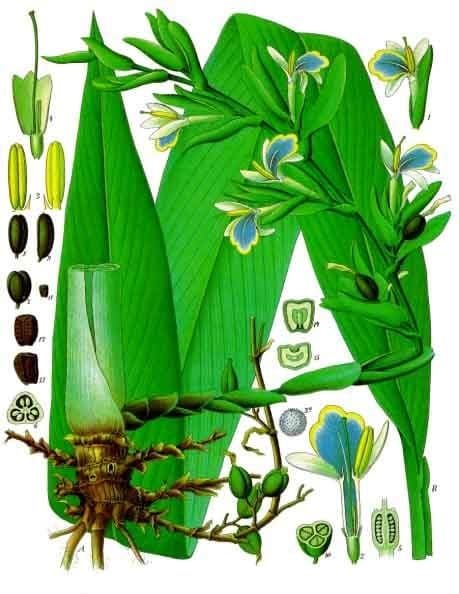
- Elettaria cardamomum L. Zingiberaceae, seeds, steam distillation. 1,8-Cineole 26.5–44.6% + α-terpinyl acetate 29.2–39.7% co-dominant fingerprint — NOT a cinnamaldehyde/eugenol driver (breaks Batch 7 pattern). Non-phototoxic, GRAS, not irritating/not sensitizing at 4%. Soft-safe profile vs the cinnamon/clove/cassia block.
- Hazards: 1,8-cineole CNS + breathing problems in young children. Contraindication: Do NOT apply to or near the face of infants or children. (Single contraindication — the simplest safety summary in Batch 7.)
- Chemistry (Lawrence 1995g p.199): 1,8-cineole 26.5–44.6% + α-terpinyl acetate 29.2–39.7% + linalyl acetate 0.7–7.7% + (+)-limonene 1.7–6.0% + linalool 0.4–5.9% + α-terpineol 0.8–4.3% + sabinene 2.5–3.8% + terpinen-4-ol 0.9–3.2% + (E)-nerolidol 0.1–2.7% + β-myrcene 0.2–2.2% + α-pinene 0.6–1.5% + geraniol 0.3–1.1%.
- No dermal cap specified (effectively framework-governed). Opdyke 1974 p.837–838: 4%/25 not irritating/not sensitizing/non-phototoxic. LD₅₀ oral rats ~5 g/kg; dermal rabbits >5 g/kg. 1,8-cineole low risk for skin irritation + sensitization (Ch.14).
- Two-species note: T&Y lists separately "Cardamon (black)" = Amomum subulatum Roxb. (greater/Nepalese Indian cardamom) — different Zingiberaceae species, 1,8-cineole 61.3% dominant, same child-face contraindication, GRAS-adjacent. This wiki page covers Elettaria (green cardamom, commercial standard); A. subulatum treated separately.
Tổng Quan
- Danh pháp khoa học
- Elettaria cardamomum L.
- Họ thực vật
- Zingiberaceae (Họ Gừng)
- Bộ phận dùng
- Seeds (Hạt từ quả sấy khô)
- Phương pháp chiết xuất
- Steam distillation / CO₂
- Màu sắc
- Clear to pale yellow
- Phân loại nốt hương
- Nốt Top/Middle
- Hương thơm
- Top / Middle note; Sweet, spicy, warm, balsamic, slightly camphorous.
- Chemotype / Cultivar
- 1,8-Cineole / α-Terpinyl acetate CT
Các quốc gia sản xuất chính
IndiaGuatemalaSri Lanka.
Tình trạng tại Việt Nam
★★☆☆☆ [Chủ yếu nhập khẩu. Tại VN phổ biến các loài họ hàng như Sa nhân (Amomum) hoặc Thảo quả đại (Lanxangia tsaoko) hơn là bạch đậu khấu thật sự].
Phân loại nốt
Top/Middle
Cường độ
6/5
Độ bền trên da
2 – 5 hours
Họ hương
Spicy
Hương đầu (Opening)(0–15 phút)
Warm, sweet-spicy, balsamic, camphorous, radiant.
Hương giữa (Heart)(15–60 phút)
Mùi gia vị ấm áp, ngọt ngào, xen lẫn vị the mát nhẹ của long não (cineole). Thanh tao và ít gắt hơn vỏ quế hay đinh hương.
Hương nền (Drydown)(1–4 giờ)
2 – 5 hours
Cường độ hương
6/5
Da khô
3/5
Safe when properly diluted.
Da dầu/mụn
3/5
Mildly antibacterial, but primarily used for body care, not facial acne.
Da lão hóa
3/5
Antioxidant properties, but not a staple anti-aging oil.
Da nhạy cảm
2/5
May cause irritation due to 1,8-cineole. Patch test required.
Da hỗn hợp
3/5
Safe when properly diluted.
Nhập khẩu** Imported
Vùng trồng / sản xuất tại VN
Gần như không trồng phổ biến E. cardamomum quy mô công nghiệp để cất tinh dầu.
Tên gọi tại Việt Nam
Bạch đậu khấuThảo quả xanh.
Trong Y học cổ truyền VN
Mặc dù bạch đậu khấu là gia vị cốt lõi của ẩm thực Ấn Độ, ở Việt Nam, gia vị phở truyền thống và Đông Y chuộng dùng Thảo quả (Lanxangia tsaoko - thảo quả đen) hoặc Sa nhân (Amomum villosum) hơn. Bạch đậu khấu (E. cardamomum) chủ yếu điểm xuyết trong các bài thuốc Bắc nhập khẩu.
Mua hàng tại VN
Đa số "Tinh dầu bạch đậu khấu" bán tại VN là hàng nhập khẩu từ Ấn Độ hoặc Guatemala. Nếu tinh dầu sản xuất nội địa ghi "Cardamom", cần cực kỳ cẩn thận kiểm tra tên khoa học, vì đó rất có thể là tinh dầu Thảo quả hoặc Sa nhân (hương vị hắc và thô hơn bạch đậu khấu thật rất nhiều).
Pha Chế & Hòa Hợp
Digestive / Antispasmodic
Relieves intestinal spasms, excessive gas (carminative), and nausea. Excellent for abdominal massage;
Ref: General Zingiberaceae studies.
Respiratory Expectorant
The 1,8-cineole content helps clear mucous and open airways.
Anxiolytic / Antidepressant
Reduces oxidative stress, influences neurotransmission for mood stabilization;
Ref: PMID 36781058.
PMID 36781058
Cardamom oil ameliorated behavioral and neuropathological disorders in depressed animal models.
In vivo (Animal)Multiple PMIDs
Strong antioxidant and anti-inflammatory activity mapping to pro-inflammatory cytokine suppression.
In vitro / In vivoTâm trạng: ** Uplifting / Balancing / Comforting
Clarityappetite for lifedigesting experiencesmental spaciousness.
Chakra
** Solar Plexus (Manipura) / Sacral (Svadhisthana)
Ngũ hành
Earth
| Phương pháp | Liều lượng | Ghi chú |
|---|---|---|
| Diffusion (khuếch tán) | 3 – 5 drops | Wonderful for clarifying the air and stimulating appetite or concentration. |
| Topical massage (massage) | 1.0 – 5.0% dilution | Excellent in abdominal rubs (clockwise) to relieve bloating or indigestion. |
| Bath (tắm) | 2 – 4 drops | Must be well diluted in a carrier before adding to bathwater. Warming and relaxing. |
| Inhalation (hít) | 1 – 2 drops on tissue | Good for mild nausea or motion sickness on flights/car rides. |
| Skincare (chăm sóc da) | ~1.0% | Can be used in warming body lotions; generally not favored for facial skincare due to cineole content. |
Dầu nền phù hợp
Sweet almond oilMild, easily absorbed, neutral scent — classic base for digestive abdominal massage blends; complements cardamom's warming profile without competing aromatically.
Fractionated coconut oilLight, non-greasy, long shelf life; excellent for topical blends requiring a clean-carrying medium, especially in warmer climates.
Jojoba waxNon-comedogenic and sebum-like composition; suitable for sensitive or combination skin formulations at low EO concentrations (0.5–1%).
Sesame oilTraditionally paired with cardamom in Ayurvedic massage; warm, slightly nutty base with linoleic/oleic acids providing complementary skin-barrier support.
Kết hợp tốt với
CitrusWoodSpiceFloral.
Blend kinh điển
—
—
—
—
[Primary safety] Essential Oil Safety (2nd Ed) - Tisserand & Young (Cardamom oil profile)
[Clinical] PMID: 36781058 (Anxiolytic/Antidepressant); General Zingiberaceae antimicrobial PMIDs
[Chemistry] Various GC/MS reports for Elettaria cardamomum (Frontiers in Pharmacology, etc.)
[VN Heritage] Từ điển Cây thuốc Việt Nam (Võ Văn Chi) - Mục phân biệt Bạch đậu khấu và Thảo quả
An Toàn
Giới hạn da tối đa
Xem chi tiết
Giới hạn IFRA
** No specific stringent limits like cinnamaldehyde/eugenol, but subject to general peroxide/monoterpene considerations.
Thai kỳ & Cho con bú
Tam cá nguyệt 1Unknown
Tam cá nguyệt 2Unknown
Tam cá nguyệt 3Unknown
Giới hạn độ tuổi
Xem chi tiết
Genuine: Should have a sweet, soft, balsamic-spice profile without smelling overwhelmingly like Eucalyptus (which implies adulteration or very poor distillation/chemotype). Adulteration risks: Frequently adulterated with cheaper synthetic 1,8-cineole or cut with closely related but harsher species like Amomum subulatum. Storage: Dark, airtight container. Oxygenated terpinyl acetates are relatively stable.
Bảo quản
Dark, airtight container. Oxygenated terpinyl acetates are relatively stable.