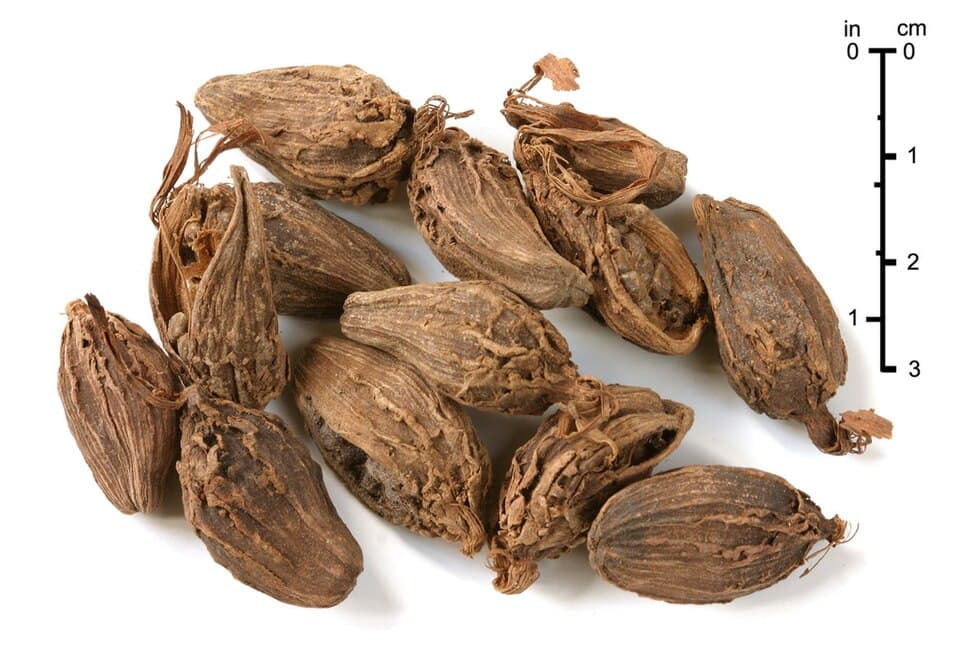
- Amomum subulatum Roxb. (Zingiberaceae), seeds, steam distillation. Black cardamom — "Thảo quả đen / Đại đậu khấu" — is a DIFFERENT GENUS from Green Cardamom (Elettaria cardamomum — see [[cardamom]]). Wiki publishes both as separate slugs to prevent safety-block cross-contamination. Nepalese / Sikkim / NE India origin; culinary + Ayurvedic usage distinct from green cardamom.
- Chemistry = 1,8-cineole dominant 61.3% (Gurudut 1996 — higher than green cardamom's 26.5–44.6%). Secondary: β-pinene 8.9% + α-terpineol 7.9% + α-pinene 3.8% + (−)-allo-aromadendrene 3.2%. No α-terpinyl acetate (green cardamom's co-dominant ester 29.2–39.7%) → olfactory profile drier + more camphoraceous, less sweet.
- Hazards: 1,8-cineole-driven CNS + breathing problems in young children. Contraindication: DO NOT apply to or near face of infants or children (same as green cardamom + eucalyptus + rosemary 1,8-cineole class). Skin sensitization LOW (1,8-cineole profile Ch.14).
- Not pregnancy-contraindicated. 1,8-Cineole + α-pinene both show low reproductive toxicity (Pages 1990 mice 100 mg/kg/day sc = no teratogenesis). No known carcinogens. Negligible subchronic toxicity <500 mg/kg (Kristiansen & Madsen 1995).
- Not phototoxic. Limited commercial availability per T&Y p.503 comment. Traditional Ayurvedic + Nepali-Tibetan culinary use. Less therapeutic research than green cardamom — most safety data inherited from 1,8-cineole constituent profile.
Tổng Quan
- Danh pháp khoa học
- Amomum subulatum Roxb.
- Họ thực vật
- Zingiberaceae
- Bộ phận dùng
- Dried fruit/seed capsule
- Phương pháp chiết xuất
- Steam distillation / Hydrodistillation
- Màu sắc
- Pale yellow to light yellow liquid
- Phân loại nốt hương
- Nốt Top/Middle
- Hương thơm
- Top-Middle; Smoky, camphoraceous-eucalyptus, earthy with sweet spicy undertone and aldehydic-woody depth
- Chemotype / Cultivar
- No significant chemotype variation; Nepal/India type: 1,8-cineole 60-73%; VN type (Lao Cai): 1,8-cineole ~29%, trans-2-undecanal 17%, geranial 14% — notably different composition.
Các quốc gia sản xuất chính
NepalIndia (Himachal Pradesh, Uttarakhand, Sikkim)BhutanVietnam (Lao Cai)
Tình trạng tại Việt Nam
⭐⭐⭐⭐ — Thảo quả là cây bản địa và cây kinh tế vùng núi phía Bắc VN
Phân loại nốt
Top-Middle
Cường độ
7/5
Độ bền trên da
1 hour – 3 hours
Họ hương
Camphoraceous
Hương đầu (Opening)(0–15 phút)
Smoky, camphoraceous, earthy, spicy-woody, bold
Hương giữa (Heart)(15–60 phút)
Khói thuốc thơm, long não ấm, đất rừng, cay nồng sâu
Hương nền (Drydown)(1–4 giờ)
1 hour – 3 hours
Cường độ hương
7/5
Da khô
2/5
1,8-cineole có thể làm khô da thêm
Da dầu/mụn
4/5
1,8-cineole kháng khuẩn; kiểm soát bã nhờn; pha ≤1%
Da lão hóa
3/5
1,8-cineole stimulates circulation nhẹ
Da thường
4/5
Dung nạp tốt ở nồng độ chuẩn ≤1%
Da nhạy cảm
2/5
Camphoraceous note và limonene (oxidized) gây kích ứng; test patch bắt buộc
Da hỗn hợp
3/5
Cân bằng vùng T; pha thấp ≤0.5%
Nhập khẩuTier 2 Premium
Vùng trồng / sản xuất tại VN
Lào Cai ★★★ (lớn nhất), Yên Bái ★★, Lai Châu ★★, Hà Giang — vùng núi cao phía Bắc, độ cao >1,000m, trồng dưới tán rừng nguyên sinh
Tên gọi tại Việt Nam
Tinh dầu Thảo Quả (Bạch Đậu Khấu Đen)
Trong Y học cổ truyền VN
Thảo quả là vị thuốc trong YHCT Việt Nam — trừ đờm, tiêu thực, ôn trung tiêu (ấm tỳ vị), chỉ nôn; trị đau bụng, nôn mửa, sốt rét; Long Châu Pharmacy đăng tải đầy đủ monograph web:142; VAFS nghiên cứu tinh dầu thảo quả trong chăn nuôi (kháng khuẩn thú y) web:136
Mua hàng tại VN
Tinh dầu thảo quả VN được chưng cất tại địa phương từ quả khô; bán tại Kobi.vn (sỉ) web:133; đặc biệt: thành phần VN type có geranial và undecanal cao — khác với Nepal/India type nên cần GC/MS CoA khi sourcing; giá tham khảo 150,000–350,000 VNĐ/10ml tùy purity
Pha Chế & Hòa Hợp
Respiratory Support
1,8-cineole là expectorant và bronchodilator đã chứng minh lâm sàng — ức chế leukotriene B4, mở phế quản, giảm mucus viscosity; Black Cardamom chứa 39–73% 1,8-cineole, một trong những EO có cineole cao nhất
Antimicrobial / Antibacterial
1,8-cineole, α-terpineol, β-pinene phá vỡ membrane vi khuẩn và nấm; BCEO kháng E. coli O157:H7 anti-biofilm, quenching quorum sensing; PMID: 23074918
Digestive Support
Truyền thống Ayurveda và YHCT Trung Quốc dùng thảo quả cho tiêu hóa, đầy hơi, buồn nôn; 1,8-cineole antispasmodic trên cơ trơn đường tiêu hóa; điều hòa miễn dịch và chống viêm (giảm IL-6, TNF-α, IL-1β, IL-8)
Antioxidant / Anticancer (in vitro)
Gây độc tế bào ung thư HepG2, HeLa, Bel-7402, SGC-7901, PC-3
Neuroprotective
Ức chế acetylcholinesterase — enzyme liên quan Alzheimer; bảo vệ thần kinh chuột trong mô hình ngộ độc nhôm clorua
Analgesic / Anti-inflammatory
α-pinene, α-terpineol, 1,8-cineole ức chế COX và pro-inflammatory cytokines
Satyal et al. 2012, PMID: 23074918
GC-MS Nepal: 1,8-cineole 60.8% (seed), 39.0% (rind); antimicrobial, antioxidant
Analytical + In vitroPMC 2021, PMC8249550
BCEO inhibits E. coli O157:H7 biofilm, quorum sensing anti-virulence
In vitroPMC 2020, PMC8046960
Composition + pharmacological activity from India và KSA
Analytical + PharmacologicalVJFS Vietnam 2024
GC-MS 36 samples Lào Cai/Yên Bái/Lai Châu: 1,8-cineole ~29%, geranial 14%, undecanal 17%
Analytical GC-MSTâm trạng: Stimulating, Grounding
Invigoratingwarmingboldprimalgrounding
Chakra
Solar Plexus Chakra (Manipura), Root Chakra (Muladhara)
Ngũ hành
Earth
| Phương pháp | Liều lượng | Ghi chú |
|---|---|---|
| Diffusion (khuếch tán) | 3–5 drops / 100ml nước | 20–40 phút; phòng bệnh mùa cúm; không để quá lâu |
| Topical massage | 1–2% dilution | Fractionated coconut hoặc sweet almond; massage ngực cho ho |
| Bath (tắm) | 5–8 drops pha với 1 tbsp carrier hoặc sữa | Warming bath; thêm Epsom salt |
| Inhalation (hít) | 2–3 drops trên khăn hoặc bowl nước nóng | 5–10 phút xông hơi mặt; tốt cho ngạt mũi, viêm xoang |
| Skincare (chăm sóc da) | 0.5–1% trong serum hoặc moisturizer | Kháng khuẩn nhẹ; không dùng cho da nhạy cảm |
Kết hợp tốt với
SpicyResinousWoodyEarthyCamphoraceous
Blend kinh điển
Frankincense + Black Cardamom— deep resinous-smoke accord; meditative incense blend
Clove + Black Cardamom— warm spice blend; mulled wine-inspired oriental base
Sandalwood + Black Cardamom— exotic woody-smoke accord; oriental masculine
Eucalyptus + Black Cardamom— respiratory powerblend; 1,8-cineole synergistic
[Primary safety] Tisserand & Young, Essential Oil Safety 2nd Ed. — 1,8-Cineole safety, dermal limits; p. [DATA-NEEDED specific page]
[Chemistry / Primary] Satyal et al. 2012\. PMID: 23074918 — GC-MS Nepal A. subulatum seed (1,8-cineole 60.8%) + rind (39.0%) — [web:141] https://pubmed.ncbi.nlm.nih.gov/23074918/ + [web:128] https://journals.sagepub.com/doi/pdf/10.1177/1934578X1200700935
[Chemistry / Uttarakhand] Academia — 1,8-cineole 73.27% dominant, Uttarakhand India — [web:135] https://www.academia.edu/84038612
[Chemistry / Vietnam] VJFS VN 2024 — GC-MS 36 samples Lào Cai/Yên Bái/Lai Châu — [web:139] http://vjfs.vafs.gov.vn/js/article/view/988
[Chemistry / Comparison] Sagepub JSFA 2012 — A. subulatum vs A. tsao-ko vs E. cardamomum detailed comparison — [web:119] https://journals.sagepub.com/doi/10.1177/1934578X19857675
[Clinical / Anti-biofilm] PMC 2021, PMC8249550 — BCEO anti-E. coli O157:H7 quorum sensing — [web:117] https://pmc.ncbi.nlm.nih.gov/articles/PMC8249550/
[Clinical / Pharmacology] PMC 2020, PMC8046960 — A. subulatum pharmacological activity review — [web:130] https://pmc.ncbi.nlm.nih.gov/articles/PMC8046960/
[IFRA Standard] Perfumer's Apprentice IFRA 51st Certificate #8305 — Cardamom EO — [web:134] https://shop.perfumersapprentice.com/Documents/IFRA-51/8305.pdf
[IFRA Secondary] Shay and Company IFRA 51st — Cardamom: not restricted most categories — [web:127] https://shayandcompany.com/wp-content/uploads/2021/03/Cardamom-Essential-Oil-51st-IFRA-Shay-and-Company.pdf
[Physical data] Annapurna Global spec — sg 0.8921, RI 1.470, optical rotation +2.99 — [web:122] https://www.annapurnaglobal.com/product-page/black-cardamom-oil
[VN Context / TCM] Long Châu Pharmacy — Thảo Quả YHCT monograph — [web:142] https://nhathuoclongchau.com.vn/thanh-phan/thao-qua
[VN Context / EO] Kobi.vn — Tinh Dầu Thảo Quả Giá Sỉ VN — [web:133] https://kobi.vn/tinh-dau-thien-nhien/tinh-dau-thao-qua-cardamom-essential-oil
[VN Context / Research] VAFS VN — tinh dầu thảo quả thú y — [web:136] https://nsti.vista.gov.vn/publication/download/hE/qFPZhqFPID.html
[Data reliability] HIGH** — GC/MS data có PMID thật (23074918); VN data từ VJFS nghiên cứu 36 samples thực địa; IFRA từ official certificates; VN context 3 sources địa phương đáng tin cậy
An Toàn
Giới hạn da tối đa
4%
Giới hạn IFRA
Yes (conditional) — IFRA restricts at Cat 1 due to limonene; most other categories not restricted
Thai kỳ & Cho con bú
Tam cá nguyệt 10.5%
Tam cá nguyệt 21.0%
Tam cá nguyệt 31.0%
Giới hạn độ tuổi
Children <2: AVOID; 2-6: AVOID topical, diffusion 1 drop/100ml ok; 6-12: 0.5%
- ! CYP1A2/CYP2B6 medications (1,8-cineole induces these enzymes in vitro)
- ! Anticoagulants (limonene — theoretical)
- x Children <2 years (1,8-cineole respiratory risk)
- x History of epilepsy (camphor content)
- x Zingiberaceae allergy
- Genuine (Nepal/India type): 1,8-cineole >40%; α-terpineol 4–12%; β-pinene 2–18% web:128web:135 - Genuine (VN type): 1,8-cineole ~29%; trans-2-undecanal ~17%; geranial ~14% web:139 - Adulteration phổ biến: Pha với Eucalyptus EO (cineole rẻ hơn); bán E. cardamomum (Green Cardamom) với label "Black Cardamom" — phân biệt bằng α-terpinyl acetate (cao trong Green, thấp trong Black) - Authentication: Specific gravity 0.887–0.912; optical rotation +2.5° đến +10°; GC-MS check α-terpinyl ace
Bảo quản
Cool, dark, airtight. Store below 20°C. Protect from oxidation — pinene content oxidizes quickly. Oxidation Risk: High